Where Is the Waterline on Your Eye? Rim & Tightline Map
Confusion between the outer lash hairline, smooth inter-lash roots, and the wet inner mucocutaneous rim causes smudged panda transfer—and unnecessary ocular gland clogging.
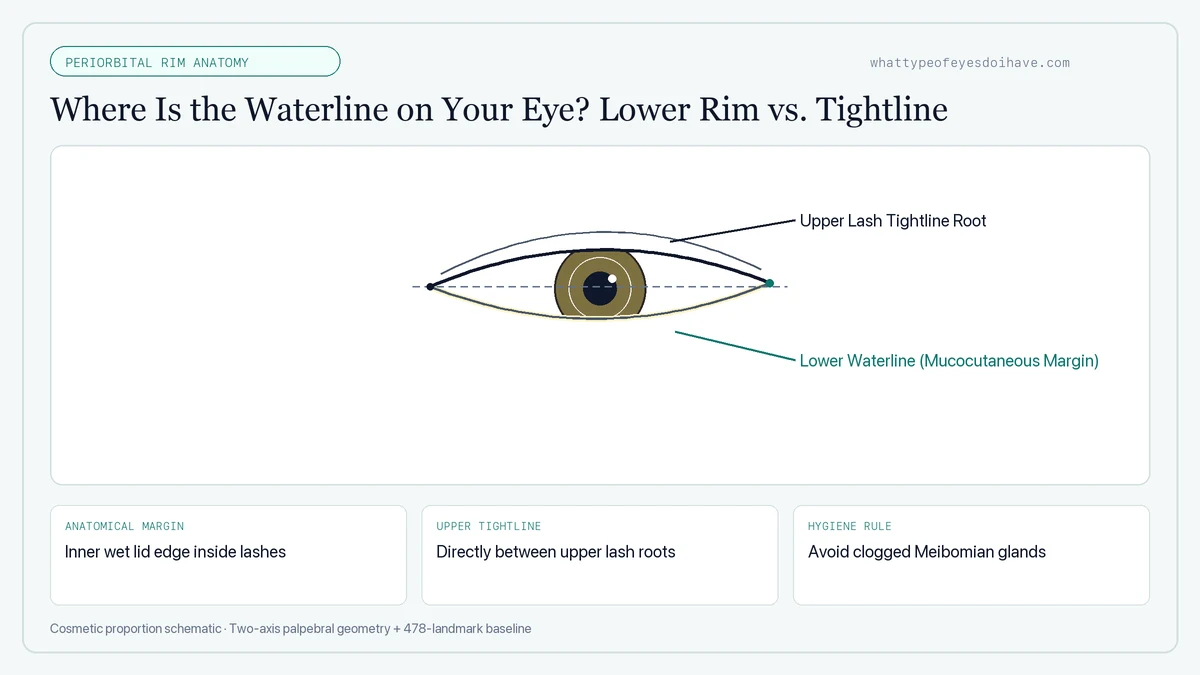
If you have ever paused mid-tutorial wondering where is the waterline on your eye before accidentally poking pencil wax straight onto wet sclera tissue, clear anatomical mapping solves both styling and hygiene instantly. Tracing where is your waterline on your eye accurately breaks the margin into three millimeter-wide zones: dry outer lash skin, inter-lash follicles (the true tightline track), and the delicate wet mucocutaneous rim housing natural lipid glands. Check whether tightlining suits your lid visibility by scanning what type of eyes do I have first.
30-Second Rim Zone & Tear-Film Check
Pull just gently near the outer cheekbone skin—avoid tugging inner moist membranes directly—to identify each millimeter margin track.
Look carefully just behind the bottom eyelash row: can you see a flat glossy pinkish strip resting squarely along the front edge touching tear moisture?
Do dark kohl strokes placed along your wet lower edge regularly clump into black dots at the medial tear corner within an hour?
Are your upper eyelid folds relatively compact or hooded, making thick eyeliner placed directly over upper skin shrink visible tarsal clearance?
Key Anatomical Benchmarks at a Glance
True Lower & Upper Waterline
Glossy inner mucosal-skin edge bordering ocular tears; home to tiny oil-secreting Meibomian gland ducts protecting tear stability.
True Inter-Lash Tightline Zone
Microscopic gap nestled strictly right between emerging eyelash shafts—creates dense dark lash lines safely outward from wet glands.
Traditional Upper & Lower Lid Edge
Dry outer skin immediately above upper lashes or below bottom lashes—ideal anchor for liquid wings and smoky matte powders.
Waterline vs Tightline vs Lash Line Anatomy & Styling Chart
Pinpoint where is the waterline on your eye vs safer root-tightening zones before selecting pencil textures.
| Eyelid Margin Zone | Exact Anatomical Boundary | Visual Optical Result | Safety & Formula Best Practice |
|---|---|---|---|
| Upper Tightline (Root Bed) | Between upper lash follicles underneath brow arch | Thickens roots invisibly; opens hooded or small lids | Use soft waterproof gel pencil pressed lightly in roots |
| Upper Wet Waterline | Smooth pink moist inner upper lid ridge | Zero bright gap underneath top lashes | Transfers onto lower rim quickly; limit to special wear |
| Lower Wet Waterline | Moist horizontal shelf behind bottom lashes | Black shrinks vertically; nude-peach widens clarity | Sharpen fresh tip; keep clear of dry/contact-lens haze |
| Outer Lower Lash Line | Dry skin immediately under emerging bottom lashes | Grounds outer wings gently without trapping glands | Smudge matte shadow safely outward via angled brush |
Pinpointing Where Is the Waterline on Your Eye Exactly
Understanding where is the waterline on your eye turns clumsy poking into crisp studio precision within thirty seconds. Along both upper and lower lid margins, skin transitions from external keratinized epidermis—where eyelash follicles emerge—across a razor-thin ridge known clinically as the gray line or mucocutaneous junction directly onto wet inner conjunctival lining resting against your cornea.
That smooth, moist pink-white shelf lying *inside* the eyelash border right along tear moisture is where is your waterline on your eye. Because wet mucosal film constantly refreshes via blinking, oils and pigments dropped across that horizontal shelf migrate straight across the tear surface toward the medial duct unless formulated for waterproof adherence.
Directly *in front* of that moist gland line lies the tiny dry bed threading squarely between emerging upper eyelash hair shafts. Confusing that dry hair-root gap with the wet inner mucocutaneous rim explains why people complain tightlining stings or blurs—true invisible lash-root thickening targets the dry follicle zone, never soaking bare moist glands.
- Ciliary Border (Outer): Dry skin supporting eyelash roots—supports every matte powder, liquid wing, and gel pot safely.
- Gray Line / Gland Row (Middle-Inner): Delicate tiny Meibomian oil pores lined just behind lashes along the rim crest.
- Inner Waterline Shelf (Moist): Glossy inner tear film strip—sensitive to chalky kohl fragments and loose shimmer flecks.
Check product labels specifically marked 'ophthalmologist tested for inner rim use' if choosing waterproof gel pencils along the wet shelf.
Upper Tightlining vs Waterline Coloring: Two Different Moves
Beauty writers casually call lining underneath top lashes 'upper waterlining', mixing two adjacent tracks carelessly. When applying authentic invisible tightlining—critical inside eyeshadow for hooded eyes and thin-lid eye makeup to make eyes look bigger—lightly push creamy waterproof espresso kohl *upward* right into the root gaps of emerging upper hairs with short wiggling dots, leaving the shiny wet inner rim behind them untouched.
Why does separating root-tightening from wet waterline lining matter? First, pressing pigment only between upper hair bases anchors ink cleanly on dry follicular skin so it stops blinking downward onto bare bottom rims. Second, leaving wet inner rim glands clear protects crisp tear comfort all workday without floating charcoal grit inside vision or on contact lenses.
Black vs Warm Brown vs Nude-Peach Along the Lower Waterline
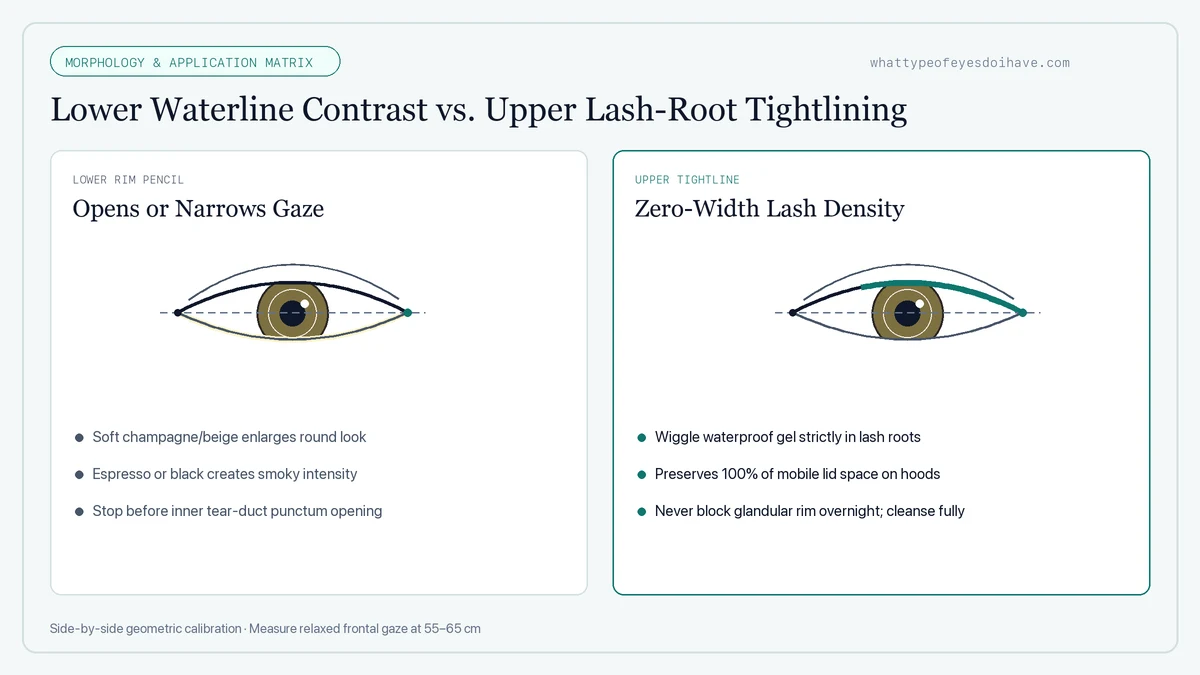
Once you pinpoint where is the waterline on your eye, hue selection acts like an adjustable architectural aperture slider. Sweeping jet black along that bottom shelf absorbs reflected light seamlessly into dark lower lashes, framing sultry smoky evenings while visually narrowing round lower scleral heights—a move best reserved for tall circular profiles needing crisp horizontal tightening (benchmark ratios in our 42-metric sample eye report).
Conversely, nudging creamy warm nude-peach or soft champagne-matte along that bottom shelf creates an optical brightness extension making bright iris circles read taller effortlessly. Soft warm bronze or muted olive along the outer third strikes balanced contrast without compressing medial space—checking your aperture proportion via what shape are my eyes confirms cleanly which rim hue fits daily harmony.
- Black Lower Waterline: Best paired with smoky nights or tall round geometry wanting sleeker horizontal edge.
- Soft Espresso / Taupe: Ideal subtle definition muted enough for warm hazel, amber, and soft fair palettes.
- Matte Peach-Nude: Visually extends bottom scleral space safely to brighten compact or narrow proportions.
Ocular Surface & Meibomian Gland Hygiene Guardrails
Knowing where is the waterline on your eye is equally critical for keeping tear glands healthy long term. Directly along that smooth rim shelf sit 25 to 40 vertical Meibomian gland orifices per lid releasing protective meibum lipids with each blink to slow tear film evaporation.
Clinical tear-film research highlighted across the international TFOS DEWS II consensus documents shows that heavy waterproof wax pencils, flaky glitter particles, and incomplete bedtime cleansing pressed repeatedly right onto gland openings increase lipid plugging and contact lens lipid deposition. Always sharpen wooden pencils freshly to strip aged dry tips, skip metallic sparkles anywhere near the wet shelf, and remove every trace gently nightly using clean non-oily micellar pads soaked along closed lashes without rubbing aggressively inward.
Keeping Clean Rim Definition Without Raccoon Transfer
Even waterproof gels break down smoothly along high-moisture surfaces unless prepped gently. For rare evenings calling for classic smoky kohl along the inner lower shelf, first sweep a pristine dry cotton bud softly once across the moist rim to lift excess watery pools cleanly, glide silky gel pigment smoothly in one pass, and allow 15 seconds holding gaze gently open before full hard blinks.
Alternatively, achieve identical rich framing with double comfort: leave the moist inner shelf completely clear while buffing creamy matte charcoal pencil strictly along the dry outer root bed immediately *below* lower lashes—combining crisp smudge security from our eyeliner shapes guide with spotless daytime ocular comfort.
Never apply waterline pencils inside moving vehicles or directly after liquid eyedrops; pause 10 minutes after lubricating drops until excess fluid settles completely.
Evidence & Field Observations
Community Patterns & Anthropometric Sources
r/MakeupAddiction & Optometry Q&A Discussions
Switching from painting wet lower waterlines daily to stamping fine pigment strictly underneath upper lash follicles ('true tightlining') stops midday lower smudging and reduces itchy contact lens haze.
Contact Lens Wearer Feedback
Reserving powdery shadows solely for dry outer lash lines while picking ophthalmologist-approved solid gel tips keeps lens clouding cleanly away.
Reference Literature
Craig JP, Nelson JD, Azar DT, et al. TFOS DEWS II Report: Ocular Surface Comfort & Cosmetic Impacts. Ocul Surf. 2017;15(3):276-283.
Documents Meibomian gland orifice location right behind lash follicles along the mucocutaneous junction and effects of cosmetic migration onto tear film lipids.
Ng A, Evans K, North RV, Purslow C. Migration of cosmetic products into the tear film. Eye Contact Lens. 2015.
Demonstrates measurably faster tear migration when pigment sits behind the mucocutaneous rim vs dry outer ciliary margins.
Cosmetic Styling & Non-Medical Scope
Anatomical rim descriptions clarify makeup placement zones alongside general hygiene habits. Always remove inner-rim cosmetics thoroughly before sleep and consult a qualified optometrist or ophthalmologist for persistent redness, dryness, or stye tenderness.
Objective Photo Measurement
Test Your Own Photo in 10 Seconds
Skip mirror guesswork—upload one straight-on photo to measure your opening ratio, canthal tilt angle, upper lid crease, and natural iris shade with our free AI detector, or inspect our 42-metric Sample Report.
Frequently Asked Questions
The lash line is the dry outer skin edge where eyelashes actually grow out, whereas the waterline sits one millimeter further inward along the smooth glossy moist membrane rim resting right against ocular tears.
Frequent pencil wax placed across the moist inner rim migrates quickly onto soft contact surfaces and lipid glands. Focusing smudge-proof liner strictly along the dry outer lash roots keeps lenses dramatically clearer.
Usually because pigment touched the shiny wet upper shelf rather than dry inter-lash follicles, or because standard creamy kohl was chosen over fast-setting waterproof gel.
Lightly tap excess tear moisture away from the lower corner with a soft tissue edge first, apply silky waterproof matte beige gel cleanly across the rim, and pause ten seconds before heavy squinting.