Two-Axis Biometric & Vision Analysis
What Type of Eyes Do I Have Test & Free AI Eye Shape Detector
Wondering what type of eyes do I have or what shape are my eyes? Upload one eye-level photo to measure your visible opening ratio, outer-corner canthal tilt, upper eyelid crease, eye spacing, and natural iris color—with zero sign-up.
Why two axes plus lid fold work better: Traditional charts mix opening width, corner angle, and eyelid skin into one confusing list—leaving you unsure whether you are almond, upturned, or hooded. Our what type of eyes do I have test scores opening ratio (round, almond, elongated), canthal tilt (upturned, level, downturned), and upper lid fold (double lid, hooded, monolid) separately so you get a complete, non-contradictory eye type verdict.
For a steadier result: face soft daylight straight-on at eye height, relax your eyebrows, and remove glasses before scanning.
Drop a straight-on photo here
JPEG, PNG, or WebP · Eyes open at camera level · No glasses
Processed in temporary memory · Never stored as a facial ID
No photo handy? Try a verified sample portrait:
Visual Reference Guide
Eye Shape Chart: Opening Ratio, Corner Tilt and Lid Fold
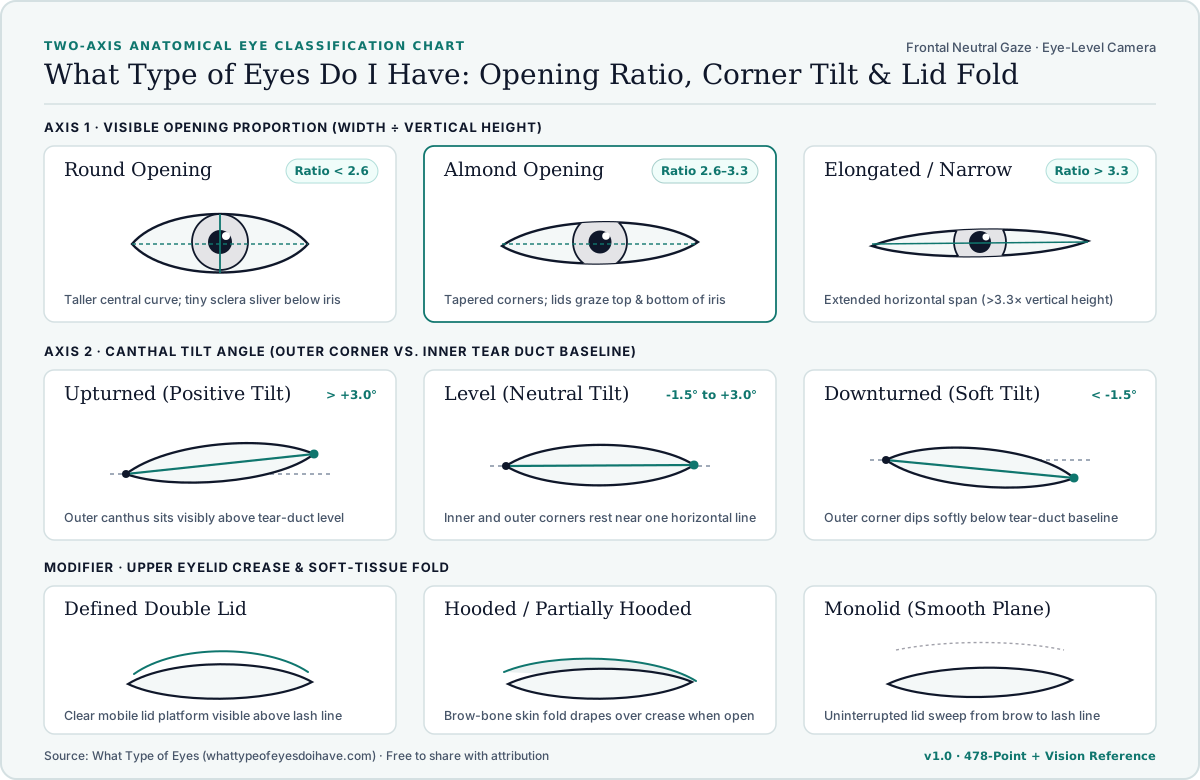
Before or after running the free AI eye shape detector, compare your reflection against the three structural rows below—an objective alternative to a subjective eye type quiz. Every type of eye shape combines one opening proportion from Row 1, one canthal angle from Row 2, and one upper-lid fold structure from Row 3.
Almond
2.6–3.3 W/HBalanced horizontal-to-vertical eye shape where upper and lower lids gently graze the iris rim and taper cleanly toward both corners.
Round
< 2.6 W/HTaller central aperture curve that reveals more vertical iris height and occasionally a fine crescent of white sclera beneath the lower iris.
Elongated
> 3.3 W/HExtended horizontal span more than 3.3 times its vertical opening height, creating a sleek lateral gaze across the middle facial third.
Upturned
> +3.0° TiltPositive canthal tilt where the outer eye corner sits noticeably higher than a straight baseline drawn through the inner tear ducts.
Downturned
< -1.5° TiltSoft negative tilt where the outer corner rests slightly below the inner tear-duct line, suited to upward-flicked outer-third liner.
Hooded or Monolid
Upper Lid FoldIndependent upper-lid crease modifier: hooded folds drape from the brow bone over the crease, whereas monolids form a smooth uncreased lid plane.
Measurement Methodology
How Our Eye Shape Test & Detector Measures Your Photo
When you ask what type of eyes do I have or compare your type of eye shape, guessing from celebrity collages rarely helps because camera focal length and brow tension distort casual selfies. Our what type of eyes do I have test combines sub-pixel 478-point landmark geometry with computer-vision crease analysis across three calibrated stages.
Horizontal Width ÷ Vertical Height
The free AI eye shape detector locates the inner tear duct (medial canthus) and outer corner (lateral canthus) on both eyes, then divides horizontal span by central open-lid height. Ratios below 2.6 read as round, 2.6–3.3 as almond, and above 3.3 as elongated.
Outer Corner vs. Tear-Duct Axis
A 2° head lean can make level eyes look upturned on raw pixel grids. Our eye shape calculator first levels the inter-ocular horizon between both inner corners, then measures exact outer canthus elevation in degrees: downturned (< -1.5°), level (-1.5° to +3.0°), or upturned (> +3.0°).
Upper Lid Fold + Inter-Eye Ratio
Because eyelid landmarks sit along the lash opening rather than the upper skin fold, vision inspection evaluates how much mobile tarsal platform remains visible above the lashes—separating defined double lids, partially hooded, hooded, and monolid eye types alongside intercanthal spacing.
Glare-Filtered Iris Chromatics
What Color Are My Eyes? The Same Photo Answers That Too
People searching what type of eyes do I have frequently sit on the border between hazel and light brown, or blue-gray and green. Every scan on our free AI eye shape detector automatically samples the mid-iris pigment ring—excluding the dark central pupil, dark outer limbal ring, and bright white window catchlights—to match your eye type with one of nine natural shades.
Because indoor tungsten bulbs add warm yellow cast and dim rooms dilate the pupil, standing near indirect daylight gives the truest iris color reading and seasonal eyeliner pairing. Read our guide on hazel, amber, green, and gray iris pigment for lighting tips.
9 Sampled Iris Reference Shades
Full 12-season complementary eyeshadow & liner hex swatches are generated automatically inside the Sample Report.
Capture Checklist
Four Habits for Accurate Eye Type Detection
Small changes in selfie angle or expression can shift your opening ratio by 0.3 points. Follow these four capture habits before running the what type of eyes do I have test:
TIP 01
Eye-Level Camera
Hold the lens straight across from your pupils at arm's length (55–65 cm). High selfie angles exaggerate upper lid show; low angles mimic sanpaku sclera show.
TIP 02
Relaxed Neutral Gaze
Avoid squinting ("smizing") or raising your eyebrows for the camera. Close your eyes for one breath, open naturally, and snap immediately.
TIP 03
Unobstructed Corners
Sweep curtain bangs away from outer corners and test with bare lids or minimal mascara so dark winged eyeliner does not extend the lateral corner landmark.
TIP 04
Remove Eyeglasses
Prescription lenses minify or magnify eye width depending on diopter strength, and frame rims cast shadows right across the inner tear duct.
Common Questions
Frequently Asked Questions About Eye Shapes & Types
Everything to know before and after using our free AI eye shape detector and what type of eyes do I have test.
Our what type of eyes do I have test separates three independent periorbital measurements instead of forcing you into a single vague eye type quiz box. First, the free AI eye shape detector measures your palpebral width-to-height opening ratio (round below 2.6, almond between 2.6 and 3.3, elongated above 3.3). Second, it calculates head-roll-normalized canthal tilt in degrees (upturned, level, or downturned). Third, vision analysis classifies your upper lid fold as double lid, partially hooded, hooded, or monolid.
Yes. You can upload a photo to find eye shape proportions immediately with zero sign-up required. Landmark mapping runs directly in your browser alongside transient crease evaluation, so you see your eye shape test verdict, tilt angle, spacing ratio, and iris shade in seconds.
Most magazine charts treat almond, upturned, and hooded as mutually exclusive buckets. In real anatomy, someone asking what shape are my eyes often has an almond opening AND an upturned corner AND a partially hooded crease at the exact same time. Measuring each axis separately removes that contradiction.
Yes. Pure 2D landmark dots only trace the lash margin where eyelids part, which cannot see skin folds higher on the lid. Our hybrid free AI eye shape detector pairs 478-point landmark geometry with computer-vision crease inspection so defined double lids, partially hooded folds, full hooded lids, and smooth monolids are identified accurately.
Hold your phone at arm's length (at least 55 cm away) at exact eye height facing a window or even daylight. Keep your head level, relax your forehead so you are not unconsciously lifting your eyebrows, take off eyeglasses, and look straight into the camera lens.
Tilting your chin up or leaning your head sideways shifts raw pixel corners on screen. Before computing canthal tilt, our eye shape analyzer establishes an inter-ocular reference axis across stable medial landmarks to subtract minor head roll so your corner angle reflects real anatomy rather than posture.
Yes—mild bilateral asymmetry of 0.05 to 0.18 in opening ratio or 0.5° to 1.8° in corner tilt is completely normal across human faces. We display your mean classification up top and include left-versus-right symmetry metrics so you can balance eyeliner thickness on each lid.
Siren eyes and doe eyes are popular styling names built on real geometry. Siren eyes typically pair an almond or elongated opening (ratio above 2.9) with positive upturned canthal tilt, whereas doe eyes reflect a rounder vertical aperture (ratio under 2.6) that exposes tall, bright iris height.
We compare your intercanthal distance—the space between your left and right inner tear ducts—against the horizontal width of one eye. Ratios near 0.94 to 1.08 read as balanced spacing, below 0.94 as close-set, and above 1.08 as wide-set.
The scanner samples an annular ring of iris pixels halfway between your dark pupil and outer limbal ring while discarding bright white window reflections and upper-lash shadows. Even indoor shadows can warm or darken hazel and blue-gray eyes, so indirect window daylight yields the truest shade.
No. Landmark geometry executes locally in browser memory, and transient vision evaluation never stores your selfie in a facial-recognition database or public gallery. You stay in complete control of your photo.
While the homepage what type of eyes do I have test is completely free, the optional one-time $17.49 dossier unlocks 42 granular periorbital and midface measurements across 7 regions, a custom 12-season iris makeup palette, optical frame bridge sizing, a 4-week styling plan, and printable PDF export.
No. Every measurement on What Type of Eyes is designed strictly for cosmetic makeup placement, lash mapping, brow grooming, photography angles, and eyewear selection—never medical, surgical, or ophthalmic diagnosis.
Deep-Dive Library
Related Eye Shape Guides & Styling Playbooks
Eye Shapes Chart: Every Major Opening, Tilt & Crease
Visual breakdown of female and male eye types with clear millimeter and ratio benchmarks.
Do I Have Almond Eyes? 30-Second Mirror & Ratio Guide
Verify the 2.6–3.3 opening band, iris grazing rule, and inner-to-outer taper.
Hooded Eyes vs. Non-Hooded Eyes: Fold & Liner Rules
Why thick lid liner transfers on hooded folds—and the bat-wing technique that fixes it.
Double Eyelid vs. Monolid: Crease Height Explained
Compare smooth monolid planes, tapered in-out folds, and parallel double creases.
Siren Eyes vs. Doe Eyes vs. Sleepy Eyes Tilt Guide
Translate viral beauty aesthetics into objective positive, neutral, and negative tilt angles.
Explore the Complete 42-Metric Sample Eye Report
See all 7 periorbital regions, 12-season iris swatches, and eyewear bridge recommendations.