Eye Makeup for Almond Eyes: Step-by-Step Proportion Guide
Balanced oval geometry does not need aggressive corrective trickery—it rewards restraint. Placing dark shades too far toward the inner third flattens the natural tapered brilliance you already own.
Mastering eye makeup for almond eyes begins with protecting crisp brightness along the inner 60% of the mobile tarsal space while letting soft contour expand cleanly along the lateral outer third. Because oval-tapered geometry naturally hits the balanced 2.6x to 3.3x width-to-height ratio, oversized inner liner or heavy bottom kohl quickly shrinks open clarity. First verify your exact lid fold and tilt via our free check for what type of eyes do I have before selecting a wing slope.
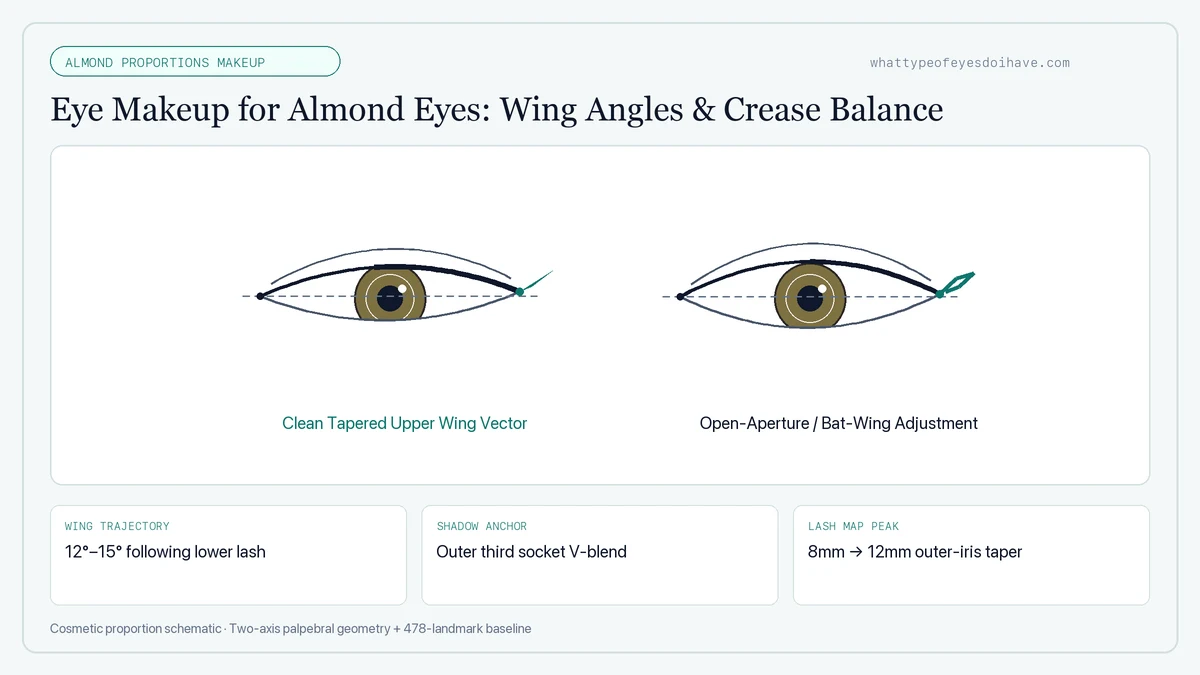
30-Second Makeup Space & Outer Tilt Audit
Pair almond outline checks with visible crease height and corner slope so you pick the right shadow placement first time.
With both eyebrows relaxed, is at least 3 mm to 5 mm of clean mobile lid visible above central upper lashes?
Looking across a horizontal line connecting inner tear ducts, does the outer corner tilt flat or gently upward?
Does inter-corner spacing across your nasal bridge match roughly the width of a single aperture?
Key Anatomical Benchmarks at a Glance
Keep the Inner 60% Luminously Light
Reserving bone matte or soft champagne along the inner two-thirds opens contrast without erasing almond oval symmetry.
12° to 15° Continuation Arc
Extending the lower rim upward at a gentle 15-degree vector maintains balanced poise without dragging the outer temple awkwardly high.
Squirrel vs Elongated Cat Flare
Squirrel mapping peaks slightly above outer iris edge before tapering—ideal for almost every almond tilt unless chasing ultra-sharp siren width.
Tailoring Eye Makeup for Almond Eyes by Crease & Tilt Subtype
Even identical almond horizontal outlines need customized wing thickness and highlight placement depending on crease visibility and spacing.
| Almond Subtype | Crease & Lid Focus | Eyeliner Rule | Recommended Lash Cluster |
|---|---|---|---|
| Classic Balanced Almond | Satin beige center + warm taupe outer V | Hair-thin inner root; 15° crisp outer flick | Squirrel curve peaking just past pupil edge |
| Hooded Almond | Lift matte contour 2-3 mm above fold wall | Micro-tightline under roots + low batwing tip | Crisp root curl + outer 9-11 mm wispie |
| Close-Set Almond | Bright pearl inner corner; deep shadow far outer | Omit inner third ink; pull outer wing further | Flare outer half outward toward brow tail |
| Wide-Set Almond | Carry soft taupe inward past medial crease | Thin dark root definition clean into tear duct | Balanced open fan centering height over pupil |
Why Classic Almond Geometry Demands Selective Restraint
Reading tutorials about eye makeup for almond eyes often leaves people holding a dozen conflicting Smokey charts simply because symmetrical proportion leaves room for bold experimentation—right up until heavy full-circle eyeliner crushes its native balance. Because upper and lower lash curves already meet the colored limbus softly without stray vertical sclera stripes, outlining both margins heavily from tear duct to outer edge builds an abrupt closed oval frame that halves perceived portrait scale.
Great eye makeup for almond eyes mirrors classical architectural proportion: leave structural lightness across the inner half so light strikes iris ring patterns cleanly, then build structured depth exclusively along the lateral outer third. This asymmetric contrast preserves vertical headroom while showcasing natural tapered outer corners without thick dark masking.
Before locking a permanent wing habit, double-check you are genuinely working with an oval-tapered 2.6x–3.3x proportion rather than narrow elongated or borderline round framing by visiting do I have almond eyes or testing what shape are my eyes automatically.
- Light-Absorbing Trap: Matte jet black spanning inner-to-outer upper lid shrinks open crease visibility rapidly.
- Three-Zone Rule: Divide upper canvas horizontally into medial light, central sheen transition, and lateral sculpted shadow.
- Lower Margin Rule: Swap thick bottom waterline pencil for bare clean skin or outer 40% warm taupe smudge.
Apply your transition contour brush horizontally first strictly across the outer third before gently buffing residual pigment inward only halfway across the center.
Zone-by-Zone Shadow Placement (From Matte Base to Outer-V)
Start with a thin transparent layer of oil-controlling lid primer from lash roots up to brow hairs, dusted lightly with skin-tone matte powder so dry brushes never catch unevenly along curved tarsal tissue. Using a pinched blending dome, sweep soft warm sandstone or cool mushroom matte along the outer half of your natural socket while maintaining relaxed forward focus—curving delicately slightly upward past your outer corner toward the brow tail.
Tap a velvety neutral pearl or soft satin rose across the bare center lid right above your pupil without dragging shimmer higher than the socket line. Using a tiny angled smudge brush, press dark espresso or charcoal satin strictly within the outermost 25% of upper and lower lash roots—buffing softly upward at 15 degrees so the triangle fades seamlessly into transition shade with zero harsh vertical boundaries.
Finish with a pinpoint tap of diffused champagne satin directly at the flat nasal inner corner—skipping chunky glitter particles that fall onto lower under-eye textures over long wear.
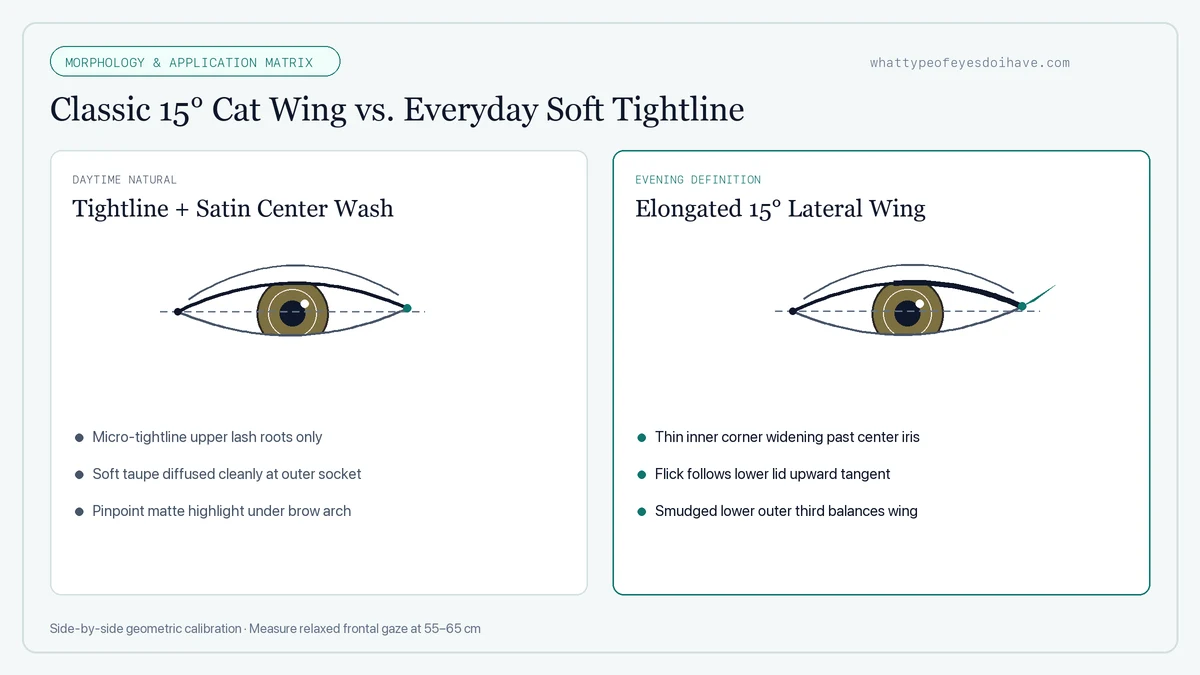
The 15-Degree Tapered Wing Calibration
Precision placement separates crisp eye makeup for almond eyes from weighed-down heavy flicks. Imagine extending your natural lower lash curve upward past the lateral corner at an even 12° to 15° incline pointing gently toward the underside of your outer brow tail. Draw that sleek bottom wing boundary first using a rigid ultra-fine liquid brush tip.
Next, look directly forward and link that crisp outer tip smoothly back onto the upper lash edge just past the lateral edge of your colored iris—keeping thickness under one millimeter across the middle and fading cleanly to nothing inside the inner medial corner. Instead of painting black ink over visible medial skin, nudge dark waterproof pencil softly underneath the inner upper lash hairline only to thicken root density invisibly.
Prefer bolder evening graphic wings or working around a slightly lowered outer fold? Cross-check your exact tip coordinates against our dedicated matrix on eyeliner shapes for different eyes alongside numeric tilt margins in the 42-metric sample eye report.
Choosing Between Squirrel and Cat-Eye Lash Maps
Lash cluster architecture reshapes eye makeup for almond eyes faster than swapping palettes. On balanced oval silhouettes, aggressive outer cat-eye falsies peaking strictly at the final outer corner hair sometimes pull the tail visually downward if lateral spacing widens or upper folds tuck near the outer rim. Instead, professional studio artists favor the Squirrel map: longest 11–12 mm clusters sit directly above your brow arch peak (above the outer edge of your iris), tapering gradually back down to 9 mm right at the true lateral corner.
Squirrel distribution catches ambient downward light cleanly without stressing delicate lateral corners downward. Conversely, if your horizontal aperture ratio leans toward crisp neutral +2° tilt with wide balanced spacing, sleek progressive Cat-Eye fibers graduating 7 mm to 12 mm horizontally accentuate feline almond elongation dramatically without hiding top iris brightness.
- Squirrel Map (Universal Daily Lift): Peaks align directly beneath the outer brow arch peak; tapers safely at final outer lashes.
- Cat-Eye Flare (Long Horizontal Poise): Steady ascending ladder stretching lateral length horizontally—best when crease is unobstructed.
- Natural Root Curl (No Falsies): Two quick root pulses with a warm metal curler + two coats tubing formula only on outer-corner wispies.
Coordinating Undertones, Brow Arches & Compact Creases
Finalizing polished eye makeup for almond eyes involves syncing upper lid pigment warmth cleanly to natural iris chroma and brow framing. Green and warm hazel apertures pop crisply against plum-taupe, dusty berry bronze, and warm terracotta mattes; cool blue-gray apertures glow beside toasted caramel, bronze copper, and espresso charcoals; rich deep browns stand out alongside emerald-olive moss, champagne gold, and burgundy.
If your natural almond geometry coincides with soft outer upper crease hooding—making straight-down shadow disappear quickly—combine bright inner placement here with open-gaze socket mapping steps from our eyeshadow for hooded eyes tutorial and tailored eyeshadow colors for green eyes and every iris palette.
Pair warm rose-bronze lid washes with a soft muted taupe brow pencil brushed strictly toward the temples rather than heavy boxy fronts to mirror oval elegance effortlessly.
Evidence & Field Observations
Community Patterns & Anthropometric Sources
r/MakeupAddiction Almond Technique Reviews
Stopping visible upper eyeliner right above the medial iris edge while tightlining beneath the inner lashes keeps almond apertures noticeably brighter and wider on smartphone front cameras.
Lash Extension & Cluster Stylist Notes
Squirrel curl mapping consistently prevents the 'droopy tail' shadow triggered by ultra-long 14 mm fibers anchored onto weaker terminal corner lashes.
Reference Literature
Farkas LG. Anthropometry of the Head and Face (2nd ed.). Raven Press.
Documents proportional lateral third shading symmetry and palpebral margin geometry.
Corson R, Glavan J, Norcross B. Stage Makeup (10th ed.). Routledge.
Foundational three-zone matte and highlight chiaroscuro shading rules for balanced orbital structures.
Cosmetic Styling & Non-Medical Scope
Liner angles, lash cluster lengths, and shadow placement strategies target visual balance in daily cosmetic application only.
Objective Photo Measurement
Test Your Own Photo in 10 Seconds
Skip mirror guesswork—upload one straight-on photo to measure your opening ratio, canthal tilt angle, upper lid crease, and natural iris shade with our free AI detector, or inspect our 42-metric Sample Report.
Frequently Asked Questions
Avoid drawing visible black ink all the way across upper and lower margins simultaneously. Keep visible wing lines focused across the outer half while pressing tightliner strictly underneath inner upper lash roots.
Rich espresso brown, bronze-taupe, or smoky plum liner defines lashes effortlessly during daylight hours while preventing harsh geometric contrast around warm irises.
Yes. Sweeping lightweight brown or black tubing mascara strictly through the outer half of lower lashes grounds strong upward wings without closing vertical brightness.
Trace an imaginary continuation connecting your outer nostril corner past your outer lateral corner toward your eyebrow tail—never pull dark matte contour outward past that clean boundary.