Eyeshadow for Hooded Eyes: Mapping Depth Above the Fold
Your pigment does not vanish because of weak formula—it hides because you painted inside the closed socket instead of mapping shadows onto the visible hood wall while looking upright.
Great eyeshadow for hooded eyes flips conventional application completely upside down: keep both lids comfortably open and staring directly forward before picking up a matte transition brush. When brow-bone tissue drapes over your mobile tarsal skin in neutral gaze, painting depth exclusively onto the hidden fold ensures every gradient disappears cleanly underneath your hood. Whether styling crisp evening shimmer or subtle office contour with eye shadow for hooded eyes, measure your exact hood overlap first via what type of eyes do I have to set safe crease height.
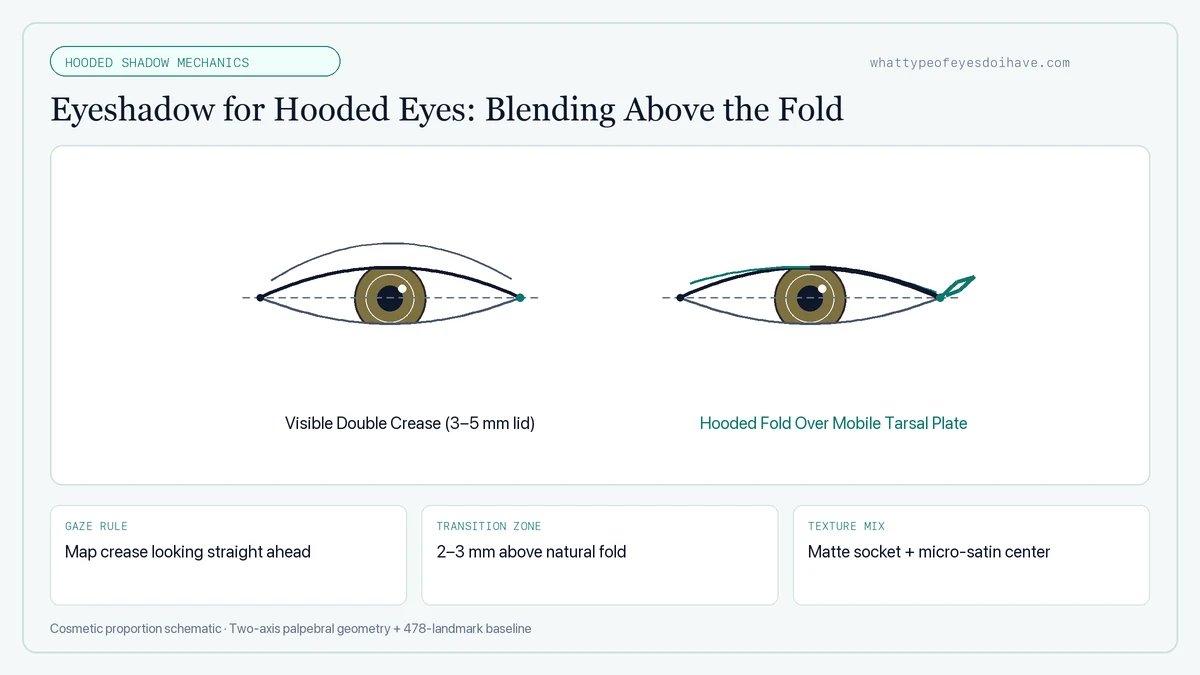
30-Second Open-Crease Placement Check
Grab any clean matte blending brush and touch your crease cleanly in level daylight without raising forehead arches.
With lids closed you see plenty of space, yet staring flat forward leaves less than 2 mm of shadow showing above central lashes?
Does dark brown crease shadow collect into a thin wet crease line within three hours even after using foundation concealer as base?
When blending outer corners toward the temple, does upper brow fold skin push matte pigment downward below your corner line?
Key Anatomical Benchmarks at a Glance
Map With Lids Calmly Open
Stare directly ahead at room mirrors when sketching your transition contour arc; never stretch brows upward or squint downward first.
Matte Recedes, Shimmer Advances
Apply soft matte cool-neutral contour across protruding fold tissue to recede projection, placing shimmer solely across flat inner thirds.
Ditch Rich Liquid Concealer Base
Emollient undereye concealer holds skin-to-skin fold oils; dry-finish polymer lid primers lock powder dry across 10,000+ blinks.
Classic Crease Habits vs Hooded-Specific Shadow Architecture
Compare why traditional closed-lid blending fails on draped hoods alongside exact corrective placement swaps.
| Application Step | Standard Non-Hooded Habit | Vanishing / Smudging Issue | Open-Gaze Hooded Calibration |
|---|---|---|---|
| Lid Priming Base | Creamy hydrating undereye concealer | Breaks down fast via skin-to-skin fold contact | Thin dry-touch silicone/polymer eye primer |
| Transition Contour | Swept inside hidden socket crease | Disappears completely once relaxed upright | Buffed 2-4 mm onto upper fold wall looking forward |
| Outer V Definition | Drawn downward into lateral corner crease | Pulled downward by drooping lateral drape | Stopped high above lateral fold angled toward brow tip |
| Shimmer Highlight | Packed richly onto mobile lid + brow arch | Spotlights forward tissue drape onto brows | Dotted strictly onto inner tear corner & lower mid-lash |
Why Looking Ahead Beats Closed-Lid Application Every Time
Almost every frustrating experience searching eyeshadow for hooded eyes traces directly back to how habits begin: tilting your chin slightly upward, lowering eyelids halfway toward hand mirrors, and patiently smoking pigment directly inside the folded crease groove. While crisp in that downward posture, the instant you relax upright toward normal height, brow-bone fold tissue slides smoothly forward and seals every blended gradient completely out of sight.
Professional studio artists fix eyeshadow for hooded eyes in under five seconds before dipping a brush into color: face straight into mirror glass at horizon level with eyebrows flat and resting, gently tap the tip of a fluffy synthetic tapered brush dipped lightly in warm mushroom or cool neutral taupe onto the upper tissue directly *above* where skin folds forward.
Treat that subtle open-gaze shade dot as an architectural false socket roughly two to four millimeters higher than your actual crease indentation. Only after marking that visible upper arc upright should you glance softly down to soften edges smoothly downward into lashes—discover exact crease exposure levels cleanly using what shape are my eyes first.
- Horizon Alignment: Position mirrors straight in front of nose bridge—never tilted up underneath chin level.
- Brush Geometry: Pinched small dome brushes place false sockets precisely without flooding upward into brow hairs.
- Symmetric Check: Step two steps back from vanity glass to compare both arcs together cleanly.
Hold your blending brush handle near the metal ferrule tip only softly near the end tail—far-end grip keeps featherlight blending pressure across delicate tissue.
Why Emollient Concealer Guarantees Crease Marks on Hooded Folds
Everyday makeup tutorials love spreading glowing creamy hydrating concealer across the lid before shadow. Across tall unobstructed open lids with minimal skin fold overlap, concealer balances veins adequately. Across hooded or eye shadow for hooded eyes anatomy, mobile skin rubs straight against brow-fold dermis through thousands of daily blinks, pumping moisture directly against facial oils.
Moisturizing glycols inside rich concealers rapidly dissolve powder binders into slick oily pools that migrate neatly into tight crease pleats within two hours. Replacing creamy concealer strictly with dedicated translucent resin/silicone eye primer—patted paper-thin and pressed dry for 45 seconds before setting with translucent silica or skin-tone matte powder—eliminates folding transfer entirely across full twelve-hour days.
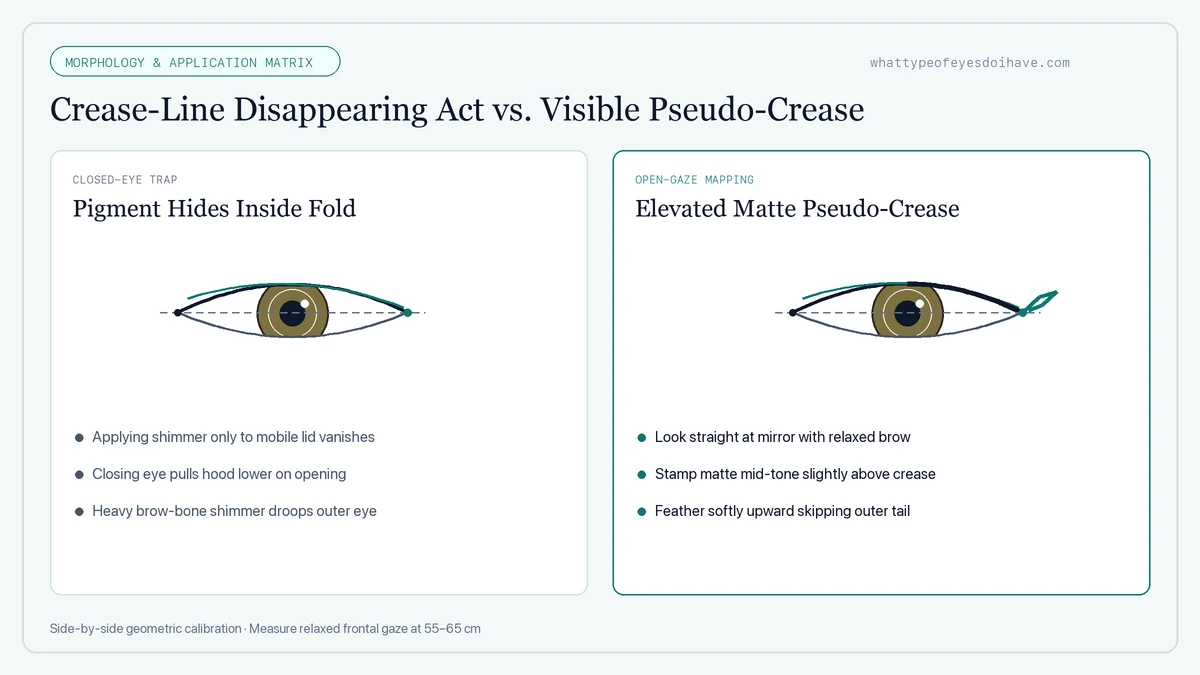
Four-Zone Matte Contour & Narrow Mobile Shimmer Strategy
Mastering eyeshadow for hooded eyes relies on pairing optical chiaroscuro principles with real fold boundaries. Light and metallic sparkle physically push planar volumes forward toward a camera lens, while smooth neutral mattes visually pull forward cushion curves softly backward into balanced contour.
Zone 1 applies subtle warm caramel-taupe or muted cool slate strictly onto that forward-protruding supra-crease hood curve using slow windshield arcs while staring forward, creating convincing open-crease illusion without frosted shimmer. Zone 2 taps deep matte espresso thinly right against outer upper lash roots and blends diagonally upward toward your brow tail tip—keeping bottom corner triangles crisply swept clean upward with zero droopy fallout.
Zone 3 adds clean brightness exclusively across flat visible pockets: soft champagne shimmer dotted cleanly over the medial tear-duct inner third and a narrow razor band along the lowest mobile rim hugging upper lashes—syncing cleanly with slim wings from our hooded vs non-hooded crease test and proportions inside our 42-metric sample eye report.
- Matte Transition Zone: Keep shades two to three steps deeper than skin tone—skip icy frosted whites directly under brow tails.
- Outer Lift Guardrail: Never allow outer dark triangle edges to fall below an imaginary line running from lower rim to outer brow tip.
- Hooded Smokey Halo: Reserve tiny center bright satin pops purely near upper central roots where lashes part slightly when relaxed.
Using Lower-Lash Shadow & Fine Tightlining to Preserve Lid Height
Thick black liquid eyeliner slices away every millimeter of scarce visible mobile space above open lashes when working with eye shadow for hooded eyes. Instead of stacking thick top strips across the lid center, curl lashes crisply upward and wiggle waterproof charcoal or dark cocoa kohl exclusively underneath upper roots from below.
Carry subtle mid-tone matte shadow lightly underneath the outer half of lower lashes as well—connecting horizontally backward into that lifted outer matte corner. Anchoring clean warmth along outer bottom tissue visually balances open vertical proportions gracefully without cramming excess layers beneath low brow space.
Avoiding Wet Cut-Creases & Over-Dark Inner Transitions
Sharp pale concealer cut-creases carved tightly below folded tissue transfer wet streaks upward into the brow wall upon the very first calm upward blink unless scaled delicately below the open-gaze false arc. Likewise, blending ultra-dark charcoal all the way past the inner pupil across heavy tissue collapses medial brightness inward rapidly.
Keep gradients softly diffused upward out over the hood transition, restrict deep charcoal shades strictly to outer corners and lash root hugs, and inspect finished geometry in calm room shadow before stepping outside. Cross-check wing geometry against our batwing and open-gaze eyeliner guide if combining winged ink simultaneously.
After finishing shadow blending, sweep an angled flat brush dipped into matte setting powder upward diagonally right beside the lower corner crease to erase accidental downward shadow drop.
Evidence & Field Observations
Community Patterns & Anthropometric Sources
r/HoodedEyes Community Consensus
Swapping rich hydrating lid concealer for thin polymer eyelid primer and drawing elevated transition arcs strictly while looking forward remain the two highest-voted fixes in community guides.
Bridal & Editorial Studio Notes
Using matte neutral brown strictly over the protruding hood rather than metallic shimmer keeps flash photography crisp with zero glare highlight puffiness.
Reference Literature
Morris R. Express Makeup: Shading Across Facial Planes. Thames & Hudson.
Foundational optical chiaroscuro principle explaining how matte absorption pulls convex upper eyelid drape visually inward.
Farkas LG. Anthropometry of the Head and Face (2nd ed.). Raven Press.
Provides upper eyelid tarsal platform versus brow-ridge depth baseline variation.
Cosmetic Styling & Non-Medical Scope
Primer choices, transition heights, and matte optical techniques address cosmetic crease behavior only and involve zero medical claims.
Objective Photo Measurement
Test Your Own Photo in 10 Seconds
Skip mirror guesswork—upload one straight-on photo to measure your opening ratio, canthal tilt angle, upper lid crease, and natural iris shade with our free AI detector, or inspect our 42-metric Sample Report.
Frequently Asked Questions
Yes—tap smooth pearl shimmer strictly onto the flat inner tear-duct corner and right against the center lower lash line, keeping the protruding upper crease hood completely matte.
Skin-to-skin contact across dynamic upper folds rubs away creamy concealer binders quickly. Dedicated dry-setting silicone primer applied cleanly onto clean bare oil-free lid skin stops folding breakdown reliably.
Looking calmly forward into a level mirror, mark a thin visible whisper of warm matte mid-tone roughly 2 mm to 3 mm above the top edge of the natural fold crease, then feather gently down into outer lashes.
Angle outer V blending softly diagonally upward following your lower rim extension toward the outer tail of the brow so dark pigment never drips down underneath the lateral corner.