Double Eyelid vs Monolid: Tarsal Crease & Makeup Guide
Whether your upper skin smoothly drapes unbroken to the lashes or folds into a clear supratarsal line comes down to micro-attachments between levator fibers and upper dermis—not opening size.
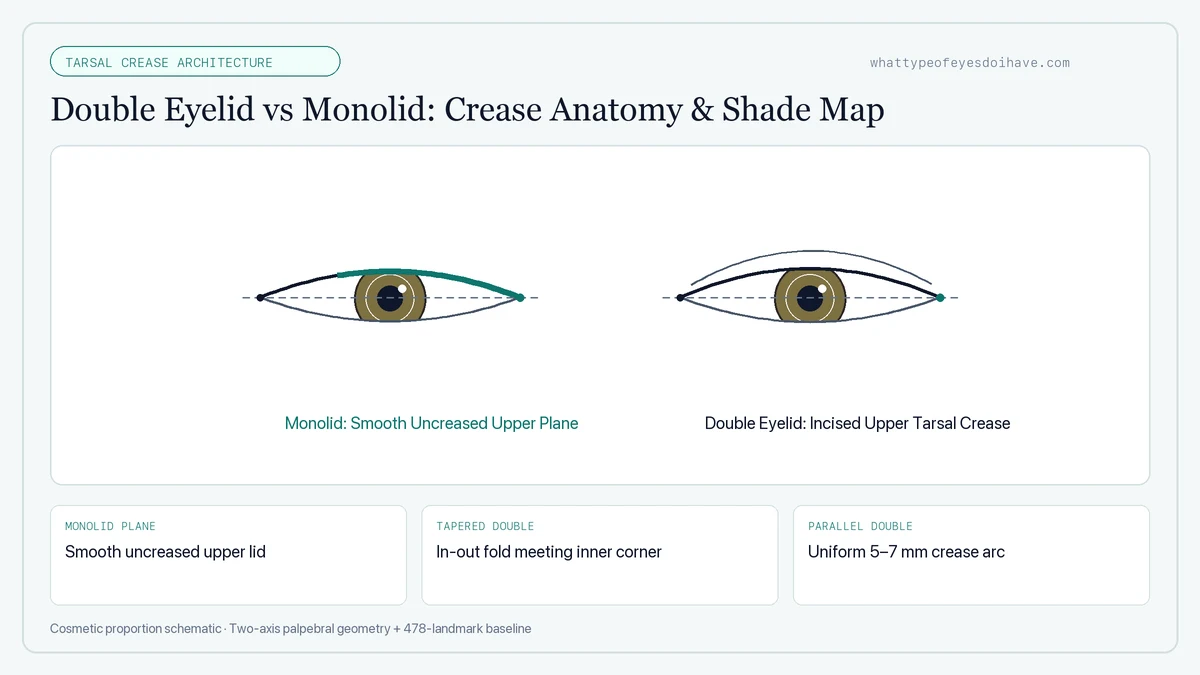
Comparing double eyelid and smooth monolid structures reveals four distinct anatomical variations rather than a blunt two-way binary. You can carry an in-fold tapered crease, a wide parallel out-fold double eyelid, a partial inner fold, or a smooth unbroken monolid—and people searching double eye lid proportions frequently miss which crease attachment pattern shapes their lashes most. Upload a straight-on portrait to find out what type of eyes do I have cleanly before building a gradient or wing routine.
30-Second Crease Attachment & Fold Mirror Check
Look flat into mirror glass in balanced ambient lighting, then slowly trace gaze upward 15 degrees and return level.
With brows lowered in forward gaze, does a distinct curved indentation sit cleanly 2 mm to 8 mm above your upper lashes from inner zone toward the outer wing?
When looking straight ahead, do your upper eyelashes point sharply forward without touching or rolling under the lower lid skin edge?
At your nasal inner corner, does upper crease lines stay visibly separated above the tear duct fold rather than merging inside it?
Key Anatomical Benchmarks at a Glance
Monolid Architecture
Lower septum tissue lies close to the tarsal plate without dermal indentation, forming an unbroken plane from brow arch down to lash roots.
Tapered Double Eyelid
Crease originates inside the medial tear-duct fold and stays slender (1.5–4 mm) across the inner half before widening toward outer edges.
Parallel Double Eyelid
Supratarsal line starts slightly above and completely independent of the medial epicanthal curve, creating tall uniform mobile space.
Monolid vs Tapered vs Parallel Crease Reference Chart
Compare dermal fold attachments, epicanthal intersections, and liner survival techniques across all four lid structures.
| Crease Pattern | Medial Corner Origin | Visible Mobile Strip | Best Eyeliner & Lash Adjustment |
|---|---|---|---|
| Continuous Monolid | Smooth epicanthal curve | 0 mm crease indent; unbroken plane | Keep thick smudged wing strictly outer; omit inner ink |
| Hidden Inner Crease | Fold tucked near lash margin | Visible only when glancing downward | Waterproof micro-tightline + upward lash curl |
| Tapered In-Fold Crease | Starts inside medial fold edge | 1.5-4 mm inner, 4-6 mm outer | Graduated thickness widening softly after pupil center |
| Parallel Out-Fold | Runs parallel above tear duct | 5-9 mm uniform end to end | Accepts balanced continuous line + defined crease depth |
What Physically Creates a Double Eyelid vs a Smooth Monolid
The structural difference between a smooth monolid and a double eyelid is purely microvascular connective anchorage—never aperture size or beauty merit. During normal upward blinking, fibers from the levator palpebrae superioris muscle lift the tarsal cartilage plate upward. When slender dermal slip fibers radiate forward from that levator tendon into the upper skin just above the tarsal plate, opening creates a clean horizontal crease.
Across smooth monolid anatomy, those anterior dermal attachments insert significantly closer to the ciliary lash margin or remain buffered by thin preaponeurotic adipose tissue. Consequently, the entire skin sheet glides cleanly as a single unbroken veil rather than pleating inward at a discrete line—which is why searching double eye lid tutorials often yields conflicting tips for smoothly contoured upper lids.
Meanwhile, many individuals discover on close inspection that they carry asymmetric crease patterns—perhaps a gentle in-fold double eyelid on the left side and a smoother low crease on the right. Measuring lid exposure neutrally via our analyzer for what shape are my eyes highlights symmetry variances clearly before picking liner widths.
- Tapered (In-Fold): Crease emerges cleanly out of the medial nasal corner and sits sleekly low (2–4 mm).
- Parallel (Out-Fold): Crease floats 5–8 mm above lashes cleanly cleared from the medial corner fold.
- Partial / Multi-Fold: Delicate secondary lines appear above an incomplete central attachment during fatigue.
- True Monolid: Unbroken taut canvas without any indented fold from brow arch down to lash roots.
Evaluate fold geometry in rested midday light; morning fluid retention subtly swells soft upper tissue and blurs subtle in-fold creases temporarily.
Tapered In-Fold vs Parallel Out-Fold Double Eyelid Shapes
Grouping every double eyelid together ignores the vital split between tapered in-fold structures and tall parallel out-folds. Tapered creases begin inside the medial corner curve so the visible mobile margin widens cleanly from zero near your tear duct to four or five millimeters near the center pupil and lateral peak.
If you paint a heavy uniform band of gel eyeliner across the inner corner of a tapered fold, the dark ink swallows all visible bare skin across that medial third, instantly shrinking brightness and closing the gaze. Keeping the inner third purely clean tightline—expanding pigment gradually past the pupil peak—respects tapered proportions seamlessly.
Parallel out-fold creases show continuous visible spacing right from inner margin to lateral flick, allowing graphic floating liners or continuous thin wings across the entire lash strip without encroaching on visible crease airiness.
Overcoming Lash Direction & Epicanthal Inner Folds
On smooth monolids and tight tapered creases, slightly thicker pre-tarsal fold skin rests right above the eyelash base, nudging hair growth at a steeper downward angle when uncurled. Without intentional root elevation, even generous mascara coats visually point straight ahead into shadows instead of lifting height upward.
Instead of squeezing an oversized curler halfway down your lashes, press a flat-curvature or shallow-arch curler directly against exposed roots with chin elevated slightly, pulsing three light taps out toward tips, then lock immediately with tubing or lightweight waterproof polymer fiber mascara. Tubing formulas coat dry roots smoothly without weighing down delicate downward-angled follicles.
When delicate inner epicanthal folds drape gently beside the nose bridge, avoid forcing dark pencil into the innermost tear trough curve; instead dot soft champagne satin onto the immediate lower medial plane to widen perceived intercanthal openness effortlessly—see our full horizontal breakdown in eye shapes chart ratios.
Vertical Lash-Root Gradient vs Traditional Crease Shading
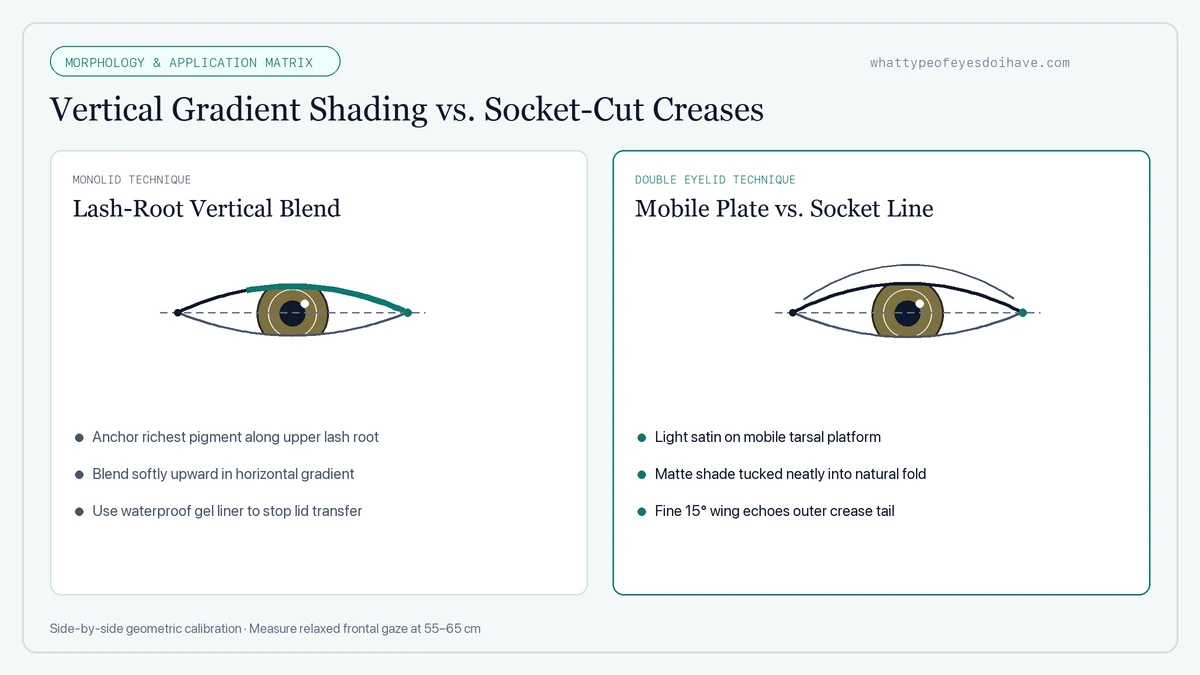
Traditional Western tutorials hinge on carving dark brown pigment directly inside a hollow socket indentation. Applied onto a smooth monolid or tight hidden crease, painting a floating brown semi-circle with zero bony crevice underneath creates awkward striped bands.
Smooth canvases look dramatically cleaner with vertical ombré diffusion: anchor deepest matte charcoal, espresso, or muted burgundy strictly within the lowest 2 mm hugging upper lash roots where real natural thickness anchors the gaze, tap a warm mid-tone bronze across the visible zone up to 6–8 mm above lashes in open focus, and buff seamlessly into skin tone below the orbital rim.
If your upper crease feels hooded near the outer temple as well, borrow open-gaze outer transition steps from our eyeshadow for hooded eyes placement guide and compare crease measurements in our 42-metric sample eye report.
- Zone 1 (0–2 mm lash root): Concentrated matte depth replaces thick distracting eyeliner bands.
- Zone 2 (2–6 mm open focus): Warm satin taupe or muted mauve transitions invisibly while upright.
- Zone 3 (outer lower third): Connect soft shadow outward at a clean horizontal tangent under outer lashes.
Preventing Ink Smudging on Tucked Lash Margins
Whether styling a sleek monolid or subtle double eyelid hidden fold, upper lid skin touches lower outer corners sharply during full blinks. Standard kohl pencils drag dark oil downward beneath lower outer lashes within minutes.
Switch completely to fast-drying brush-tip liquid pens or polymer gel pots pressed straight between upper roots, then trace extended wing tails outward strictly horizontally after clearing the lateral crease termination. Setting lower under-lash skin lightly with sheer translucent powder absorbs trace skin oils all afternoon cleanly.
Use thin translucent blotting paper gently across upper tarsal lids 30 seconds after primer so waterproof liner pen ink grips bone-dry surface friction.
Evidence & Field Observations
Community Patterns & Anthropometric Sources
r/MonolidMakeup & r/AsianBeauty Tutorials
Consistent before/after feedback demonstrates that replacing thick inner-to-outer upper eyeliner with vertical dark-to-light gradient shadowing opens smooth lids dramatically without shrinking vertical height.
Studio Curler Feedback
Flat-radius curlers matched to shallower frontal orbital curves pinch far less than deep Western curlers and lift downward-tilted roots cleanly.
Reference Literature
Kunjur J, Sabesan T, Ilankovan V. Anthropometric analysis of eyebrows and eyelids. Br J Oral Maxillofac Surg. 2006;44(2):89-93.
Documents tarsal crease presence, epicanthal fold incidence, and lid platform height differentials.
Chen WPD. Comparative anatomy of the upper eyelid crease. Asian Blepharoplasty and the Eyelid Crease.
Describes levator aponeurotic dermal termination height distinguishing single lids, tapered folds, and parallel creases.
Cosmetic Styling & Non-Medical Scope
This guide maps cosmetic shading gradients, curler geometry, and waterproof liner mechanics across monolid and double eyelid folds strictly for makeup styling—never medical or surgical consultation.
Objective Photo Measurement
Test Your Own Photo in 10 Seconds
Skip mirror guesswork—upload one straight-on photo to measure your opening ratio, canthal tilt angle, upper lid crease, and natural iris shade with our free AI detector, or inspect our 42-metric Sample Report.
Frequently Asked Questions
Yes—unilateral or uneven crease attachment is completely common. Balance both gazes visually by keeping inner lash lines bare and placing soft mid-tone gradient shade visible at equal heights above open lashes.
Across tapered creases and sleek monolids, upper lid margins roll inward slightly upon opening. Thick center lines hide beneath the skin margin while eating up clean space; micro-tightlining roots plus extending a slim horizontal outer wing preserves fullness.
A tapered crease originates from inside the medial epicanthal fold and stays slim near the nose before widening outward, whereas a parallel crease sits noticeably separated above the inner tear duct curve.
Cosmetic tapes temporarily fold superficial skin forward while worn, but baseline anatomical classification remains tied to your resting unassisted crease attachments.