Siren Eyes vs Sleepy Eyes: Canthal Tilt, Sclera & Liner
Viral social trends turned anatomical terms into personality labels—yet siren eyes and sleepy or doe silhouettes come down to three reversible numbers: opening ratio, outer tilt degrees, and lower iris margin coverage.
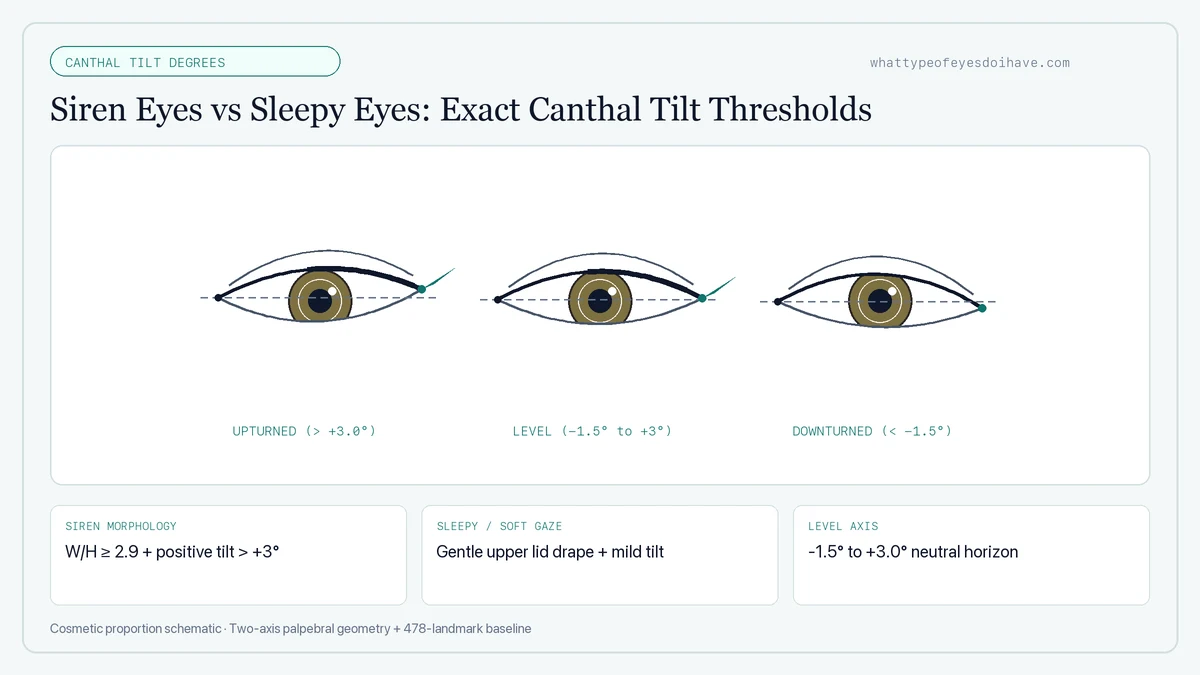
Sorting out siren eyes vs sleepy eyes cleanly requires stripping away filters and looking closely at palpebral geometry. What social clips call siren framing hinges on elongated horizontal width (>3.1x), subtle outer corner upward lift, and tight upper-margin iris drape—while sleepy or soft doe framing exhibits taller opening height, calm neutral-to-negative tilt, and rounder iris exposure. Measure your real resting angle in crisp daylight using our free analyzer for what type of eyes do I have instead of chasing fleeting trend edits.
30-Second Canthal Tilt & Resting Aperture Check
Snap or face a bright mirror straight at nose-bridge level without smiling or raising cheeks.
Follow an imaginary horizontal line between both inner tear ducts: do your lateral outer corners angle noticeably upward above that plane?
Does your upper lid margin drape calmly across the top 15% to 20% of the colored iris while leaving zero white strip underneath?
Does the horizontal fissure look sleek and horizontally stretched rather than vertically round and open?
Key Anatomical Benchmarks at a Glance
Siren Geometric Profile
Anchored by horizontal width >3.1x height, positive +2° to +7° lateral slope, tapered corners, and zero exposed lower white sclera.
Sleepy & Doe Baseline
Characterized either by relaxed low upper-margin poise covering the upper iris or rounded vertical openness showing faint lower sclera.
Cosmetic Illusion Mechanics
Inner-beak black liner pulls spacing inward and extends horizontal illusion 12–15%, whereas central pearl brightens vertical doe height.
Siren vs Sleepy vs Classic Doe vs Sanpaku Visual Aesthetics
Distinguish true facial landmarks behind popular online naming debates.
| Trend Style Term | Aperture Ratio | Canthal Slope | Iris & Sclera Contact Signature |
|---|---|---|---|
| Siren Frame | 2.95x - 3.60x | +2° to +7° Positive | Upper rim rests calmly near pupil edge; zero bottom white |
| Sleepy / Bedroom Frame | 2.60x - 3.20x | -2° to +2° Neutral | Calm low upper lid margin resting slightly over upper iris |
| Doe / Round Frame | Below 2.55x | -3° to +1° Soft | Tall central arch showing crisp rounded lower iris rim |
| Inferior Scleral Reveal | Any ratio | Often upward chin pitch | Faint lower white sclera gap visible beneath resting iris |
Decoding the Real Landmarks Behind Siren vs Sleepy Gazes
Debating siren eyes vs sleepy eyes on social clips misses a crucial anatomical point: most striking visual shifts come from camera lens elevation, slight head pitch, and eyelash grooming rather than exotic bone genetics. True underlying landmarks reduce down cleanly to aperture aspect ratio, canthal tilt angle, and upper tarsal resting height relative to the top iris border.
Natural siren proportions feature horizontal extension exceeding three times vertical height alongside crisp positive lateral tilt where outer commissures rise gently above tear-duct height. Meanwhile, classic sleepy or soft bedroom framing rests the upper margin subtly lower across the top of the iris—conveying relaxed composure effortlessly—or gently drops lateral slope slightly below horizon.
Whenever curiosity pushes people to test what shape are my eyes objectively, keeping camera lens strictly level at eye height prevents upward chin tilting from faking lower scleral show or downward eyebrow lowering from exaggerating moody lid drape.
- Tilt Distortion Alert: Tilting chin slightly down + glancing up at camera forces synthetic siren upper-lid coverage on virtually any round gaze.
- Lens Perspective: 0.5x ultrawide lenses stretch peripheral outer corners upward unfairly when held within 30 cm.
- Neutral Reality: Stand at arm's length behind a calm expression to read real tilt degrees accurately.
Compare two portraits taken two minutes apart—one gazing strictly horizon level and one tilting chin 10 degrees forward—to verify how subtly posture alters iris overlap.
Where Bottom Sclera Reveal (Lower Sanpaku) Fits In
Online discussions comparing siren eyes vs sleepy eyes also bring in traditional Japanese visual terms like lower *sanpaku*, which simply describes seeing a slender crescent of white sclera beneath the lower iris rim during forward repose. Far from mysterious omen mythology, mild inferior scleral visibility shows up naturally on round vertically arched orbits, slight positive facial tilt, or naturally tall lower fissure curves.
When crisp bottom sclera combines with thick dark outer mascara and a calm low upper lid, observers sometimes label the sultry contrast sleepy-edgy—popularized widely across film icons. Stylists easily tighten or celebrate that ratio simply by adjusting where pencil touches: hugging dark neutral taupe gently along the inner lower lash line balances bottom contrast visually, while skipping bottom ink celebrates dramatic doe openness.
Drawing Convertible Siren Eyeliner Without Shrinking Spacing
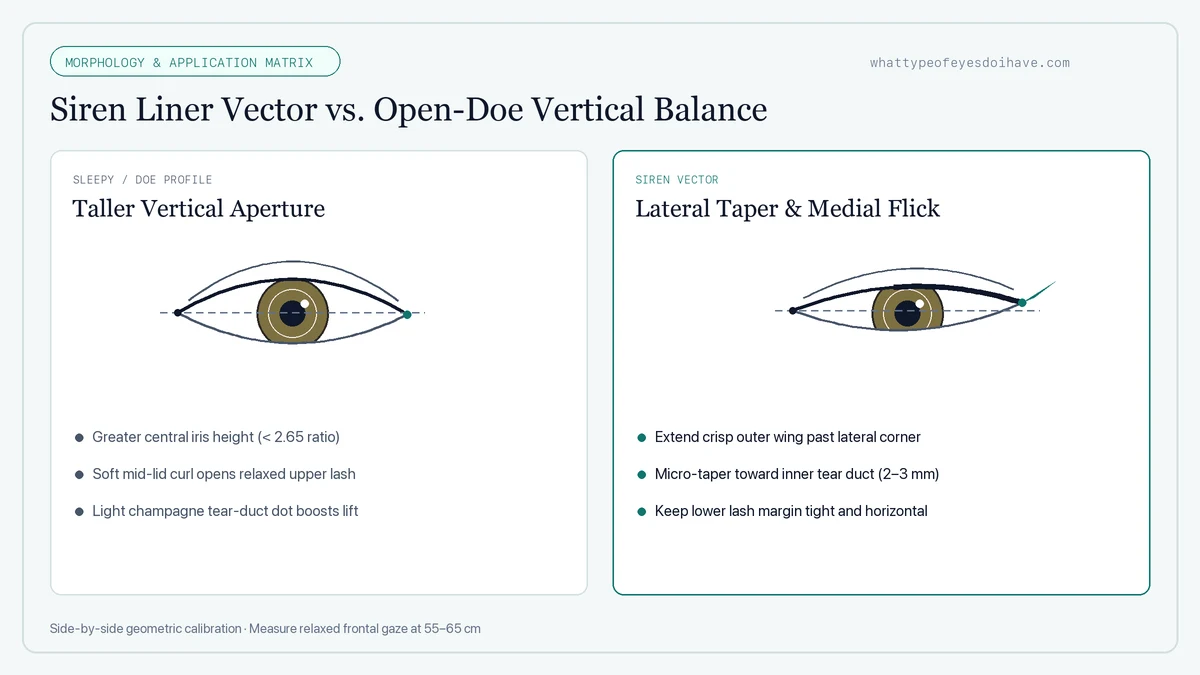
Want to shift a balanced almond or doe baseline temporarily into crisp horizontal siren proportion? Everything runs along a straight diagonal tangent stretching horizontally from the inner tear duct past the outer corner tail. Using a fine micro-tip liquid waterproof pen, project a subtle 2 mm inward triangle extending gently toward the nose bridge—mirroring medial tilt downward cleanly.
At the outer edge, stop halfway across the lid rather than carrying a heavy thick line across the middle top; anchor pigment only along the outer third before shooting a razor-thin nearly flat wing straight out toward the upper temple edge. Leave center lid matte and satin-light so horizontal drag completely outperforms vertical arch height. Check exact positive tilt adjustments inside our upturned eyes eyeliner guide and review spacing symmetry norms in our 42-metric sample eye report.
- Spacing Check: Close-set spacing (< 0.90x aperture width) should keep inner tear-duct beaks subtle (1 mm) so spacing avoids pinching visually inward.
- Wing Elevation Angle: Aim around 5° to 10° horizontally rather than steep 35° vertical arcs.
- Lash Sweep: Curl center lightly; pull false strip accents or coat outer lashes diagonally outward.
Enhancing Soft Sleepy & Doe Proportions Deliberately
Trying to force extreme cat-eye siren geometry onto tall rounded vertical curves often splits attention awkwardly—making bright doe shapes look pinched sideways rather than open. If your baseline leans toward sleepy eyes or tall doe geometry, embrace vertical center emphasis and diffused outer charm instead.
Curl middle upper lashes directly upward to clear top iris brilliance in indoor lighting, sweep glowing pearl-champagne strictly along the central top margin right above the pupil, and soften lower rims cleanly with skin-toned peach liner instead of harsh charcoal. Keep lateral wings concise so soft dreamy composure stays crisp and deliberate.
Cat-Eye vs Doll-Eye Lash Mapping Mechanics
False lash silhouette controls the balance between siren eyes vs sleepy eyes far faster than complex multi-color blending gradients. Cat-eye or fox-eye cluster placement graduates progressively from tiny 6 mm inner threads to dramatic 12–13 mm outer flicks angled diagonally sideways toward the brows—instantly extending horizontal tension.
Conversely, classic doll-eye or spiky open-frame mapping centers the tallest 11–12 mm clusters squarely vertically above the iris center while tapering cleanly down to 7 mm at both medial and lateral borders. Knowing which baseline structure you already wear via our complete eye shapes chart lets you either amplify native charm or flip proportions cleanly in three minutes.
Apply individual outer-corner lash flares 1 mm inside your real last hair rather than right on the drooping corner tip so the lateral corner never gets pulled downward.
Evidence & Field Observations
Community Patterns & Anthropometric Sources
r/Vindicta & Beauty Geometry Breakdowns
Controlled comparisons confirm that 'siren eyes' tutorials largely replicate lateral inner-corner eyeliner beaks paired with neutral chin tilt—not separate anatomical eye classes.
Cosmetic Lash Artist Patterns
Swapping central long Doll lash clusters for swept-out Fox outer flares shifts perceived palpebral ratio visibly toward horizontal siren symmetry in unretouched photos.
Reference Literature
Rheese SH, et al. Quantitative evaluation of lateral canthal tilt in balanced facial attractiveness profiles. Aesthetic Plast Surg. 2012.
Measures positive versus neutral-negative canthal slant thresholds across balanced portrait cohorts.
Farkas LG. Anthropometry of the Head and Face (2nd ed.). Raven Press.
Documents palpebral fissure inclination angles and lower scleral contact benchmarks.
Cosmetic Styling & Non-Medical Scope
Canthal tilt measurements and siren-versus-sleepy framing labels represent aesthetic geometry and eyeliner styling terminology only—not medical sleep conditions or ocular muscle disorders.
Objective Photo Measurement
Test Your Own Photo in 10 Seconds
Skip mirror guesswork—upload one straight-on photo to measure your opening ratio, canthal tilt angle, upper lid crease, and natural iris shade with our free AI detector, or inspect our 42-metric Sample Report.
Frequently Asked Questions
Natural relaxed bedroom poise is simply a harmless resting upper lid height resting gently across the upper iris margin. Noticeably sudden, asymmetric, or vision-blocking lid drooping warrants professional optometric evaluation.
Yes—by elongating strictly past the outer third with thin horizontal flicks paired with tight central upper lash curls rather than dragging thick lines vertically upward.
Use great restraint on close-set spacing (< 0.90x fissure width): thick dark inner beaks visually crowd nasal width inward. Opt for a microscopic 1 mm smudge instead.
Measuring at +2.5 degrees or steeper between the inner medial tear duct and outer lateral corner consistently classifies cleanly as positive upward canthal tilt.