Eye Shapes Chart: Different Types of Eyes, Ratios & Lids
Most online eye charts lump lid folds, corner tilt, and opening proportion into one vague list. Separating those three measurable axes shows your exact geometry in seconds.
When you compare portraits against an eye shapes chart, confusing an almond silhouette with a hooded crease or a positive canthal tilt is the fastest way to pick the wrong liner angle. Measuring horizontal opening width against vertical fissure height alongside upper lid behavior reveals which styling rules genuinely match your proportions. If you want automated 478-landmark measurements before comparing different types of eyes, upload a neutral front-facing photo to find out what type of eyes do I have in seconds.
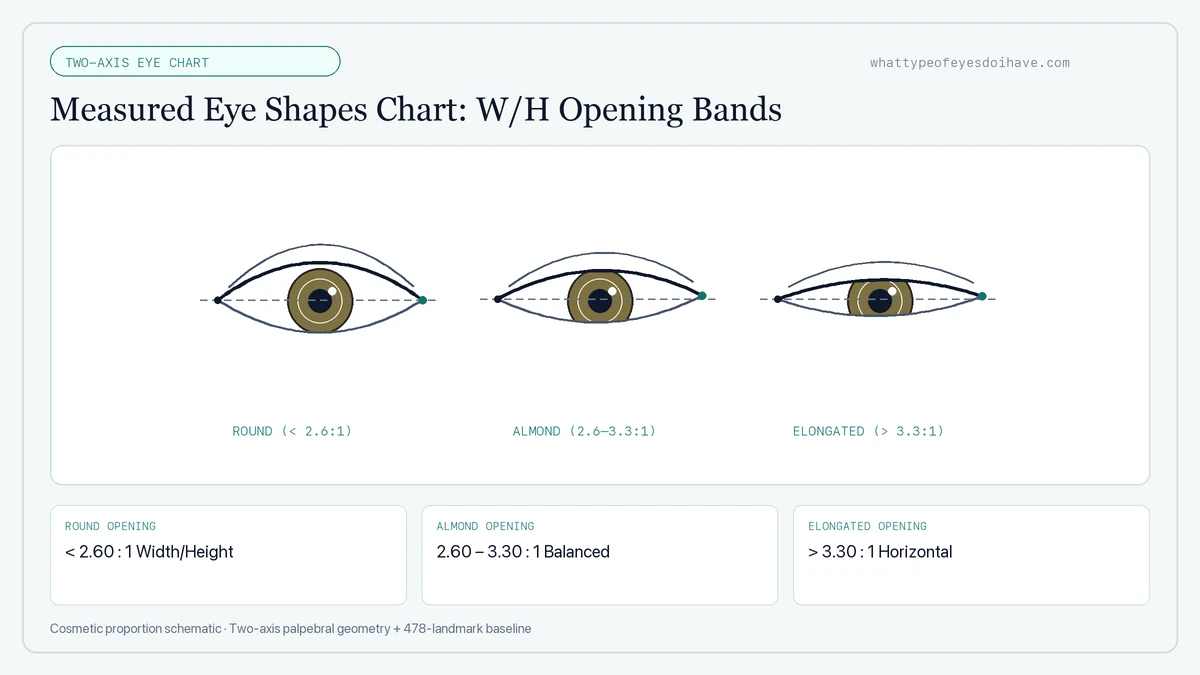
30-Second Three-Axis Mirror Baseline
Stand in diffuse window light looking directly at your bridge without raising your forehead or squinting.
Does the widest horizontal span noticeably exceed vertical opening height (roughly 2.6x to 3.3x width to height) with upper and lower rims touching the colored iris edge?
When relaxed in straight-ahead gaze, does a brow-bone fold drape over or hide the mobile upper crease?
Draw a level imaginary line across both inner tear ducts: does each outer corner sit noticeably higher than that horizontal baseline?
Key Anatomical Benchmarks at a Glance
Round vs Almond vs Elongated
Compares horizontal fissure width against vertical opening height: round opens under 2.55x, almond spans 2.60x to 3.30x, elongated exceeds 3.35x.
Visible Crease vs Hooded vs Monolid
Tracks how upper tarsal skin folds during neutral straight-ahead focus rather than tilted-chin makeup selfies.
Upturned vs Neutral vs Downturned
Measures the angular slope in degrees connecting medial endocanthion to lateral exocanthion.
Measured Reference Matrix Across 7 Common Types of Eyes
Use this structured eye shapes chart to match clinical aperture proportions, iris contact clues, and optimal wing angles.
| Feature Classification | Width / Height Ratio | Iris Rim & Crease Clue | Primary Styling Priority |
|---|---|---|---|
| Almond | 2.60x - 3.30x | Top & bottom lids touch colored limbus gently | Balanced 12° outer wing; keep inner corner open |
| Round / Prominant | Below 2.55x | Visible white sclera above or beneath iris edge | Tightline upper rim; extend soft smoky flick outward |
| Elongated / Narrow | Above 3.35x | Compact vertical opening with sharp corners | Satin center-lid shimmer + curled middle lashes |
| Hooded Fold | Any ratio | Upper fold drapes over crease in straight gaze | Place transition matte 2-3 mm above natural fold |
| Monolid / Smooth | Any ratio | Continuous flat upper lid margin without crease | Vertical lash-root gradient upward toward socket |
| Upturned (+3°+) | Avg 2.7x - 3.2x | Outer corner visibly above medial tear duct line | Lower outer-third smudge balances lifted outer edge |
| Downturned (-2°-) | Avg 2.5x - 3.1x | Outer corner dips below medial tear duct axis | Stop liner 2 mm early and flick upward cleanly |
Why Single-Label Charts Create Constant Confusion
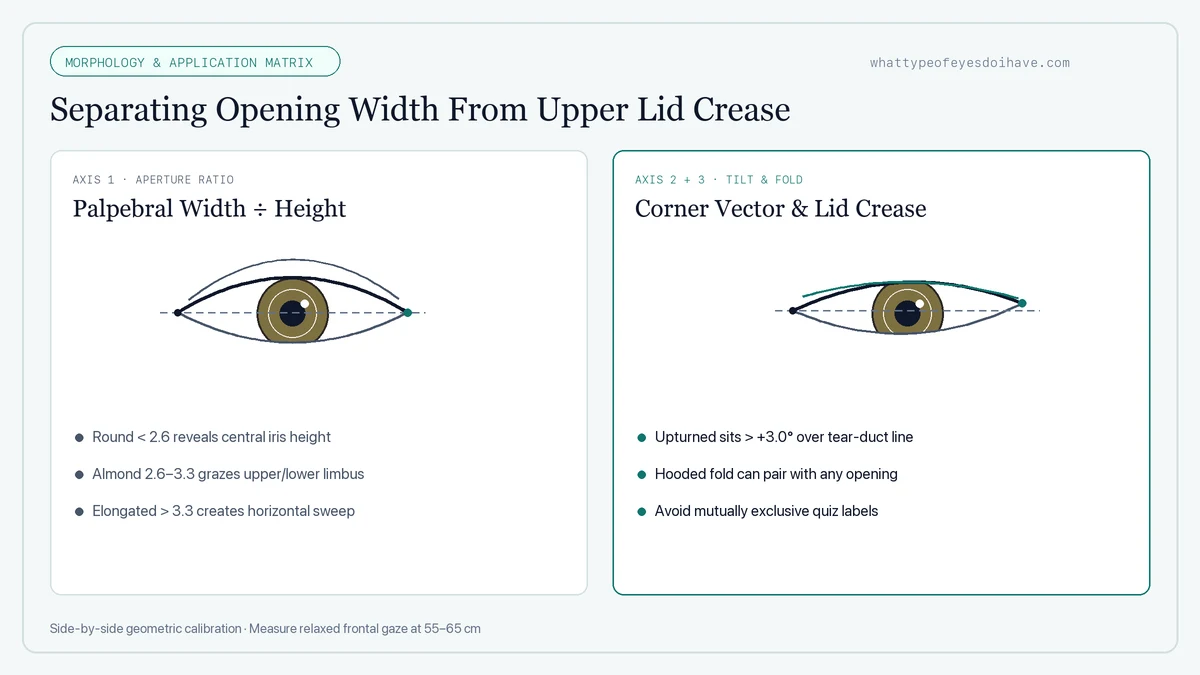
Standard beauty infographics treat types of eyes as mutually exclusive boxes, forcing you to pick either almond or hooded when half of real portraits hold both traits simultaneously. Aperture shape describes the diamond-like outline framed by upper and lower margins, whereas hooding describes whether supra-orbital skin folds downward across that mobile lid surface.
Think of different types of eyes as overlapping layers rather than competing labels. One person can possess a classic 2.9x almond fissure paired with deep-set sockets and negative canthal tilt, while another carries a rounder 2.4x aperture behind a smooth monolid without a supratarsal crease. Separating bone depth, lid fold, and horizontal opening eliminates contradictory tutorial advice.
Rather than guessing from illustrations shot under studio ring lights, photograph your face at arm's length with chin parallel to the floor. Checking what shape are my eyes automatically decouples aperture width-to-height ratio, degree of lateral tilt, intercanthal spacing, and fold overlap so every label carries concrete numeric evidence.
- Axis 1 (Aperture Ratio): Divides endocanthion-to-exocanthion width by central palpebral fissure height.
- Axis 2 (Upper Fold): Evaluates mobile tarsal skin visibility above the lash line while relaxed.
- Axis 3 (Canthal Axis): Calculates tilt in degrees between medial and lateral corners against horizon.
- Axis 4 (Spacing & Depth): Compares intercanthal distance against a single palpebral fissure width.
Never inspect lid creases while tilting your chin back in a vanity mirror. Lowering your brows intentionally relaxes the frontalis muscle and reveals true hooding depth.
Axis 1: Separating Almond, Round, and Elongated Apertures
Palpebral fissure width-to-height proportion determines how horizontal or circular your open gaze reads at conversational distance. Clinical facial anthropometry places average balanced apertures near 2.8x to 3.1x, where lateral narrowing tapers cleanly toward both corners and neither upper nor lower white sclera shows above or beneath the iris ring in relaxed forward focus.
Round apertures drop below roughly 2.55x, displaying a taller vertical arch through the central pupil zone alongside faint lower scleral reveal. Narrow or elongated apertures cross 3.35x, producing sleek horizontal framing where vertical highlight placement becomes essential to maintain vertical openness. Reviewing our dedicated check for do I have almond eyes breaks down the exact limbus boundary markers.
Spacing interacts closely with aperture proportion as well. Close-set spacing sits under 0.90 single fissure widths across the nasal bridge, balanced spacing holds between 0.92 and 1.08, and wide-set proportions exceed 1.12 widths—dictating whether inner-corner brightness helps or widens spacing unnecessarily.
Axis 2: Crease Visibility, Hooded Folds, and Orbital Depth
Upper lid anatomy depends on levator aponeurosis insertion points along the tarsal plate. A visible crease shows uninterrupted skin between lash roots and the upper fold edge; partially or fully hooded geometry places the brow-bone tissue forward or lower so that mobile platform tucks inward during forward focus.
Smooth lids lacking an indented supratarsal fold—commonly termed monolids—present an unbroken canvas above the lashes, often paired with an inner epicanthal curve blending upper skin smoothly down toward the nasal bridge. Our step-by-step comparison covering double eyelid vs monolid anatomy illustrates how tapered versus parallel folds behave under thin eyeliner.
Socket depth forms an independent structural dimension behind the lid skin. Prominent brow ridges cast overhead shadow across deep-set orbits regardless of crease size, whereas flatter maxillary rims let ambient overhead light illuminate the full lid uniformly.
- Open Crease: 3 mm or more of visible mobile skin remains exposed in neutral straight gaze.
- Partial Hood: Inner crease stays clear while outer brow fold softens the lateral third.
- Full Hood / Heavy Lid: Supra-orbital drape meets or rests near the upper lash margin.
- Monolid Canvas: Smooth uninterrupted upper skin requiring vertical shade transitions.
Axis 3: Measuring Canthal Tilt Without Camera Distortion
Canthal tilt tracks whether your lateral outer corner sits higher, level with, or lower than the medial tear duct. A positive slope above +2.5 degrees produces natural upward lift often styled into cat-like silhouettes, neutral spans stay between -1.5 and +2.5 degrees, and negative tilt below -2 degrees imparts softer doe-like expressions.
Wide-angle smartphone selfie lenses positioned closer than 30 centimeters artificially barrel-distort corners downward or exaggerate nasal width. Stepping back one arm's length on a 1x rear lens—or previewing normalized calibration inside our 42-metric sample eye report—prevents perspective skew from mislabeling neutral tilt as downturned.
Canthal tilt dictates how high eyeliner tails should travel. Level or gently downturned corners look lifted when liner tracks straight out from the lower waterline tangent upward, whereas strongly upturned corners look sharpest with shorter micro-wings that echo natural elevation without turning overly vertical.
Translating Your Chart Coordinates Into Daily Styling
Once every trait sits on its proper axis on an eye shapes chart, product placement stops feeling trial-and-error. Aperture width dictates where contrast sits (inner light for compact round shapes versus vertical shimmer for elongated narrow widths), while fold depth controls texture and placement height.
For instance, a downturned round portrait paired with partial hooding combines three clear cues: keep lower waterline bright or clean rather than smoked out, apply transition matte shades slightly above the fold while looking forward, and lift wing thickness strictly at the outer fourth toward the temple peak. For complete liner maps matched by shape, read our visual guide to eyeliner shapes for different eyes.
Consistent brow architecture anchors all three dimensions. Pairing medial brow density and arch placement to your socket line guarantees your frame harmonizes with upper lid weight rather than competing against it.
Write down your three baseline numbers—width ratio, fold type, and tilt angle—before testing new palettes so you modify one variable at a time.
Evidence & Field Observations
Community Patterns & Anthropometric Sources
r/MakeupAddiction Tutorial Discussions
Users frequently realize tutorials 'fail' not from poor blending skill, but because an almond crease tutorial was modeled on a deep-set non-hooded lid rather than a hooded almond aperture.
r/HoodedEyes Geometry Threads
Consistent feedback shows mapping transition pigment strictly with both eyes relaxed open prevents wing distortion that occurs when stretching the outer temple during application.
Reference Literature
Farkas LG. Anthropometry of the Head and Face (2nd ed.). Raven Press.
Foundational normative datasets for endocanthion-exocanthion palpebral fissure widths, orbital spacing, and fissure height across adult populations.
Kunjur J, Sabesan T, Ilankovan V. Anthropometric analysis of eyebrows and eyelids: an inter-racial study. Br J Oral Maxillofac Surg. 2006;44(2):89-93.
Documents palpebral fissure slant angles, supratarsal fold heights, and intercanthal ratios across diverse facial cohorts.
Cosmetic Styling & Non-Medical Scope
All measurements, ratio bands, and classifications on this page exist purely for personal beauty styling, optical symmetry education, and cosmetic mapping—not medical diagnosis or clinical evaluation.
Objective Photo Measurement
Test Your Own Photo in 10 Seconds
Skip mirror guesswork—upload one straight-on photo to measure your opening ratio, canthal tilt angle, upper lid crease, and natural iris shade with our free AI detector, or inspect our 42-metric Sample Report.
Frequently Asked Questions
Yes. Aperture proportion and lid fold are completely independent traits. You can simultaneously have a 2.9x almond opening, a partially hooded upper fold, and slight +3 degree upward tilt.
Capture a straight-on photograph from about 60 to 80 centimeters away in even frontal daylight with a neutral expression, or use our free browser landmark scanner to measure horizontal width versus vertical height automatically.
Legacy beauty charts mix three variables into one list. Without separating horizontal opening ratio from upper fold coverage and corner slant, subjective labels overlap constantly.
Bony orbital width stays stable in adulthood, though softer upper lid fullness or slight lateral laxity over decades can gradually add subtle hooding to an originally open crease.