Do I Have Almond Eyes? The Objective Proportion Check
Instead of staring into a mirror wondering do I have almond eyes, two concrete landmarks settle the question immediately: top-and-bottom iris contact and a 2.6x to 3.3x horizontal-to-vertical aperture ratio.
Across facial styling communities, do i have almond eyes remains the single most debated mirror question—largely because people confuse visible crease depth or upward corner slant with oval-tapered aperture geometry. True almond shaped eyes show oval-tapered lateral corners paired with upper and lower lash margins touching the colored iris edge gently during relaxed straight gaze. Want computer-vision precision right now? Run our browser test for what type of eyes do I have to measure exact width-to-height coordinates automatically.
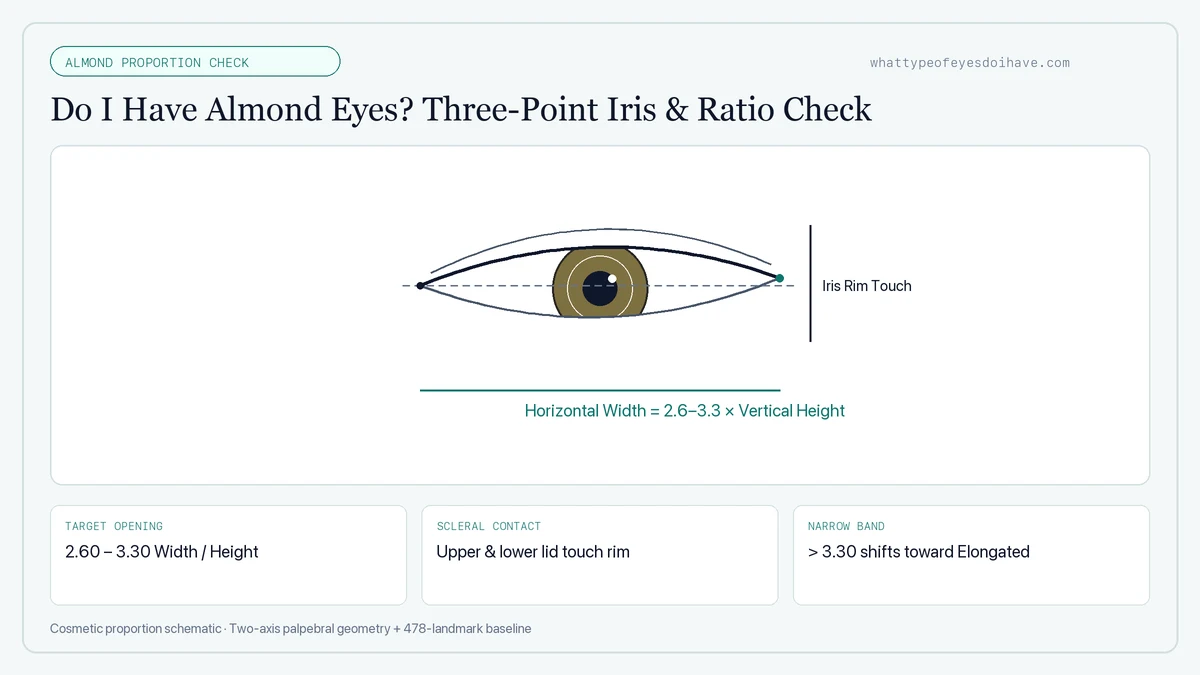
30-Second Almond Geometry & Iris Rim Check
Look flat into a mirror at head height in balanced daylight with eyebrows completely relaxed.
With your head level and gaze centered, do BOTH the upper lid border and lower rim gently contact or tuck slightly over the colored iris circumference?
Do both medial and lateral corners taper to neat pointed angles rather than curving in a wide semicircular arc?
Does horizontal opening distance look close to three times the vertical pupil opening height?
Key Anatomical Benchmarks at a Glance
Zero Upper or Lower Sclera Gap
Relaxed almond margins kiss the circular iris edge at 12 and 6 o'clock rather than exposing white sclera strips.
2.60x to 3.30x Clinical Band
Tall enough for crisp visible iris balance yet horizontally tapered at both medial and lateral commissures.
Can Still Be Hooded or Downturned
Almond outlines frequently coexist with upper fold drape or neutral/negative tilt—two separate styling axes.
Almond vs Lookalike Shapes: Exact Landmark Differences
If friends disagree when you ask 'are my eyes almond shaped?', compare these four structural markers side by side.
| Shape Category | Aperture Ratio | 6 O'Clock Iris Contact | Outer Corner Taper |
|---|---|---|---|
| Classic Almond | 2.60x - 3.30x | Lower margin gently meets iris bottom edge | Symmetrical oval taper meeting neatly |
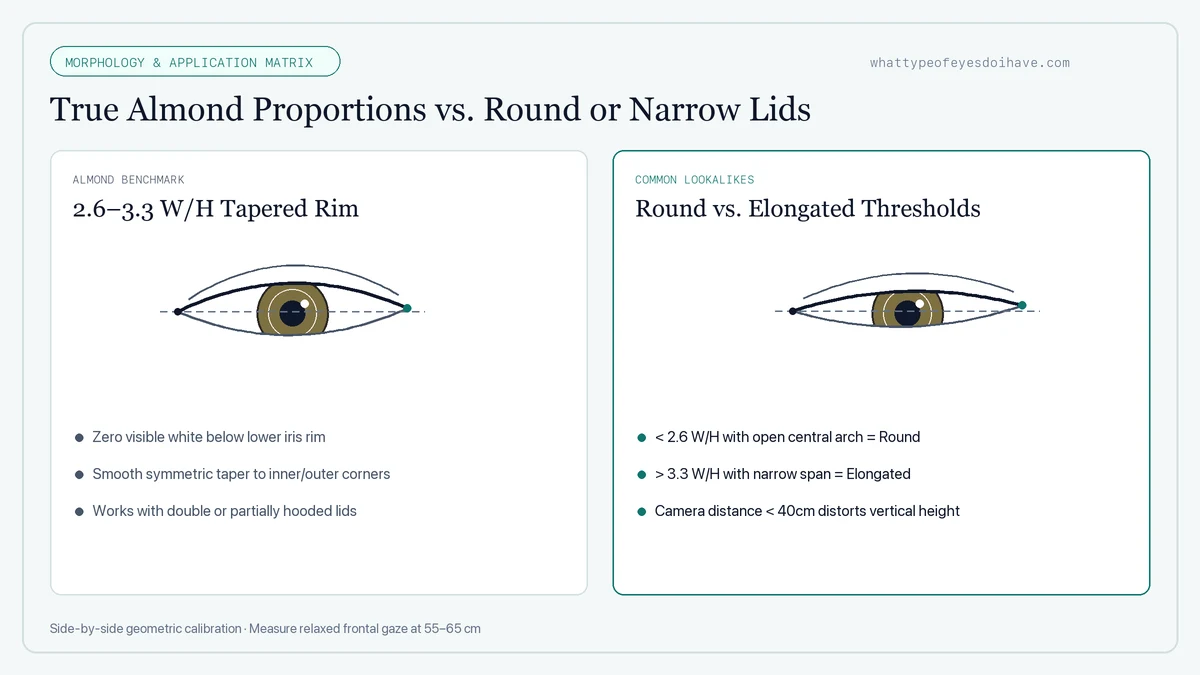
| Round Aperture | Below 2.55x | Clear 1-2 mm white band visible beneath iris | Wide arched curve stays rounded |
| Hooded Almond | 2.60x - 3.30x | Lower margin touches iris normally | Upper crease folds over outer third |
| Elongated / Narrow | Above 3.35x | Upper & lower margins overlap more iris | Sharp, compressed horizontal slit |
| Upturned Almond | 2.65x - 3.25x | Contacts iris with +3° or higher tilt | Lateral canthus rises above medial level |
Three Objective Landmarks That Confirm Almond Proportions
Anyone typing do i have almond eyes into search usually receives poetic analogies about nuts instead of measurable coordinates. In anthropometric measurement, true almond framing comes down to two perpendicular proportions and how both eyelids meet the colored circular limbus at rest.
First, measure overall horizontal fissure span between inner medial tear duct and outer lateral corner divided by vertical palpebral height above the pupil. Almond shaped eyes consistently land between 2.60x and 3.30x. Second, examine the 12 o'clock and 6 o'clock edges of your colored iris in level head posture: both upper and lower rims softly meet or overlap the iris border by a fraction of a millimeter, leaving horizontal white sclera flanking left and right—never underneath.
Third, trace corner taper. Unlike wide circular apertures whose curve maintains uniform arc height until very near the temple, almond geometry gently narrows horizontally along its outer fourth to form balanced oval tips. Testing what shape are my eyes quantifies that exact pixel ratio in less than five seconds.
- Relaxed Chin Posture: Tilting chin up creates false lower sclera show (making almond appear round); tilting chin down creates false upper overlap.
- Natural Focus Target: Look directly into the rear camera lens—avoid glancing downward toward a preview screen at the bottom edge.
- Zero Smiling Tension: Smiling lifts cheek tissue and tightens lower lids upward, artificially inflating perceived width ratio.
Take your test snapshot with hair pulled away and spectacles removed in even indoor daylight facing a window to avoid harsh shadow lines.
Almond vs Round Apertures: Why Lighting Tricks People
Distinguishing almond proportions from borderline round geometry causes more mirror misreads than any other shape pairing. When a portrait features large expressive irises paired with an open double crease, observers routinely misclassify genuine almond shaped eyes as round simply because the iris occupies noticeable space.
Round framing reveals two reliable tells: total width-to-height stays under 2.55x, and a crescent of white sclera remains faintly visible along the bottom edge of the iris even while looking straight ahead with a calm brow. Contrastingly, subtle almond apertures keep that bottom rim snug along the lower lash curve while narrowing horizontally toward the outer corner.
Styling diverges immediately between the two. Round openings tighten cleanly with inner upper tightlining and stretched horizontal flicks; true almond structures look distorted when over-pulled sideways and instead peak effortlessly with crisp outer-third definition.
Why Hooded and Monolid Creases Can Still Be Almond
A widespread online misconception claims that having an upper lid fold or lacking a deep supratarsal crease disqualifies someone from answering yes to do i have almond eyes. That confusion mixes aperture shape with lid-crease anatomy.
An upper lid hood only modifies how much mobile tarsal skin shows above the lashes when your gaze rests level; it does not reshape the lower lash rim or change whether medial and lateral corners taper into an almond silhouette. Many hooded almond pairs display exact 2.85x fissure geometry and zero lower sclera gap, requiring only higher transition matte placement rather than different horizontal elongation.
If upper skin covers part of your crease while your aperture still hits 2.6x to 3.3x, combine outer-third lifting tips from our hooded vs non-hooded crease test with balanced framing techniques from our almond eye makeup guide.
Positive, Neutral, and Negative Tilt Inside the Almond Family
Because canthal tilt operates orthogonally from horizontal opening width, you can identify upturned almond, neutral almond, and downturned almond variants using a simple horizontal line across both tear ducts. Positive slopes (+3° or higher) deliver built-in lifted tails associated with feline framing, neutral zones (-1.5° to +2.5°) showcase classic symmetry, and mild negative slopes gently soften expressions.
Checking all three values side by side inside our 42-metric sample eye report reveals why a one-size-fits-all wing fails even two people who both answered yes to do i have almond eyes. Positive-tilt almond corners already ascend naturally and shine with shorter smoked outer flicks, whereas gently downturned almond corners lift gracefully using crisp 15-degree wings originating before the exact outer tip.
- Neutral Almond (-1° to +2°): Universal balance; handles kitten wings, soft halo shimmer, and classic puppy wings equally.
- Upturned Almond (+3° to +7°): Lower outer-third soft taupe balances pronounced upward flicks.
- Downturned Almond (-2° to -5°): Lift wing baseline slightly inward from extreme edge to counteract dip.
Clean Makeup & Brow Moves Once You Confirm Almond Geometry
Confirming do i have almond eyes frees you from aggressive corrective reshaping. Because your aperture already holds near-classic horizontal taper, heavy thick black bands wrapping all the way around both margins will actually shrink perceived scale unnecessarily.
Focus pigment strategically: trace ultra-thin upper lash-root definition widening gently across the outer third, keep lower margins soft with neutral bronze-taupe dusted strictly under the outer 40% of lashes, and taper subtle shimmer toward the inner third to maximize clarity without breaking proportion.
Pair that with eyebrows peaking cleanly above the outer iris edge (roughly 65% to 70% along brow length). Read our complete eye shapes chart if you want to compare spacing or lid depth simultaneously.
Instead of tracing full black eyeliner along your lower rim, try muted taupe pressed right between outer lower lashes to preserve natural almond taper.
Evidence & Field Observations
Community Patterns & Anthropometric Sources
r/MakeupLounge & r/Sephora Proportion Threads
Members asking whether they have round or almond framing repeatedly discover that slight downward head pitch in selfies creates artificial lower scleral show, leading to unnecessary 'elongating' wing tutorials.
Pro Editorial Studio Notes
Makeup artists classify genuine almond silhouettes first by checking lower limbus touch in neutral resting gaze before deciding where shadow depth starts.
Reference Literature
Park DH, Choi WS, Yoon SH, Song CH. Anthropometry of Asian eyelids by age. Plast Reconstr Surg. 2008;121(4):1405-1413.
Measures palpebral fissure widths, upper lid heights, and medial-lateral inclination angles across adult cohorts.
Farkas LG, Katic MJ, Forrest CR. International anthropometric study of facial morphology in various ethnic groups. J Craniofac Surg. 2005.
Establishes standardized endocanthion-exocanthion width and vertical palpebral aperture reference intervals.
Cosmetic Styling & Non-Medical Scope
Geometric ratios and limbus markers detailed here provide structured styling orientation for cosmetics and portrait framing; they are not clinical or ophthalmological assessments.
Objective Photo Measurement
Test Your Own Photo in 10 Seconds
Skip mirror guesswork—upload one straight-on photo to measure your opening ratio, canthal tilt angle, upper lid crease, and natural iris shade with our free AI detector, or inspect our 42-metric Sample Report.
Frequently Asked Questions
Yes. Partially hooded almond proportions are very common because lid fold anatomy operates independently from horizontal aperture shape and tapered outer corners.
Looking upward naturally shifts the iris toward the upper lid, exposing lower white sclera on almost everyone. Evaluate limbus contact strictly during straight, relaxed forward focus at camera height.
Aperture ratios between 2.50x and 2.65x form a transitional zone. Check corner taper and 6 o'clock iris contact—sharp corners touching the iris point toward compact almond rather than true round.
Yes—when positive canthal tilt accompanies almond proportions, keeping wings concise (roughly 10 to 15 degrees) prevents exaggerated vertical lift while balancing the outer lower lash line.