Hooded Eyes vs Non-Hooded Eyes: Crease Fold & Liner Guide
You cannot spot hooding by closing your lids or raising your brows in front of a mirror. True fold behavior appears only when both brows relax completely in straight-ahead focus.
Understanding hooded eyes vs non hooded crease mechanics explains instantly why classic cut-creases vanish when you blink or why liquid wing flicks stamp awkwardly onto the brow fold by noon. Rather than guessing from downward vanity angles, comparing mobile lid height in neutral frontal repose separates clear tarsal platforms from partially hooded and full brow-drape folds. Upload a neutral straight portrait to our analyzer for what type of eyes do I have to verify upper crease visibility alongside canthal tilt.
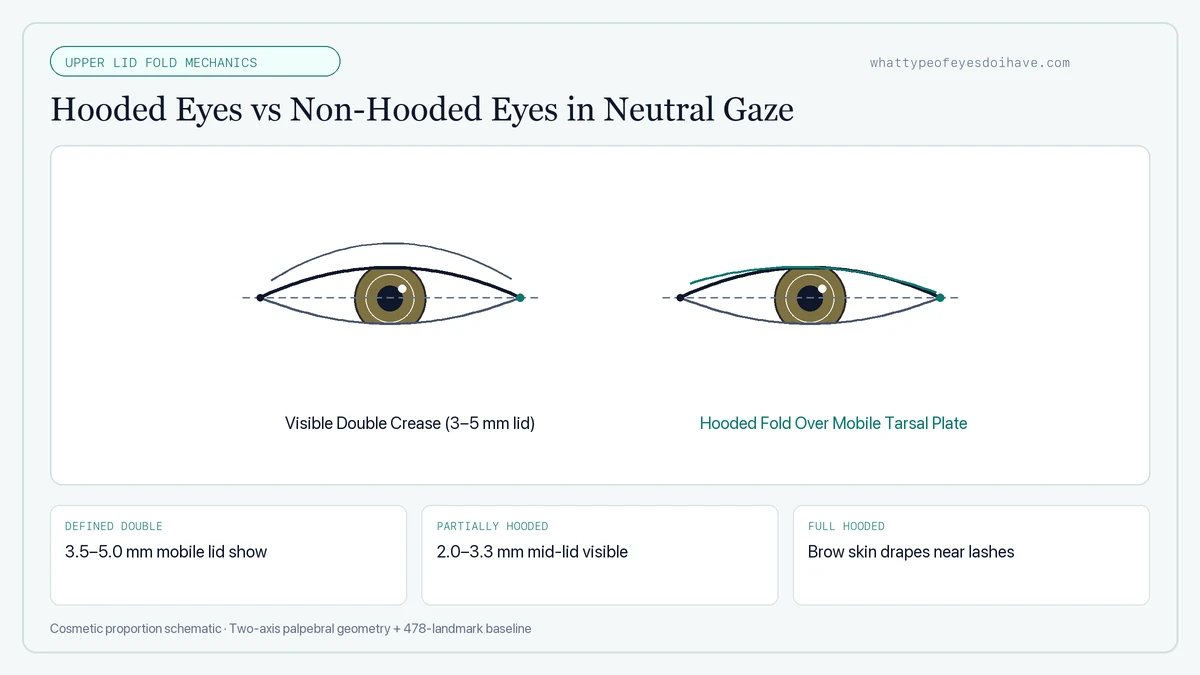
30-Second Relaxed Brow Fold Test
Place one fingertip lightly across your forehead to stop involuntary brow lifting, then gaze directly ahead.
With your forehead still and eyebrows relaxed, can you clearly see an uninterrupted strip of smooth lid skin above the central upper lashes?
Does upper skin near the brow bone crease lightly over or touch the outer third of your lash margin?
Do pencil shadows and winged liner regularly smudge onto your upper lid fold within two hours of open blinking?
Key Anatomical Benchmarks at a Glance
Full Visible Mobile Platform
Tarsal skin spans visibly above lashes from inner tear duct to outer wing, keeping traditional crease depth crisp.
Clear Inner, Draped Outer
Most common real-world variant: inner platform stays bare while upper tissue folds over the outer-third tail.
Hidden Tarsal Margin in Repose
Soft upper fold rests near or touches the lash strip while forward-facing, shifting eyeshadow upward onto the hood itself.
Hooded Eyes vs Non-Hooded: Practical Geometry & Application Map
Spot where your fold rests at neutral horizontal focus and match the corresponding primer, liner, and transition height.
| Crease Spectrum | Visible Mobile Skin | Liner & Wing Geometry | Matte Crease Transition |
|---|---|---|---|
| Non-Hooded Open | 3-6 mm visible end to end | Thin-to-medium classic 15°-25° outer wing | Blend directly inside natural socket indentation |
| Slightly / Partially Hooded | Visible medially; tucked laterally | Skip middle thick line; extend straight tail outward | Raise outer V 2 mm above fold with gaze level |
| Moderately Hooded | 1-2 mm strip over central pupil | Tightline upper water rim + micro-flick past crease | Sweep matte shade 2-4 mm onto upper fold wall |
| Deeply Hooded / Heavy | 0-1 mm visible when relaxed | Skip upper lid line entirely; batwing outer corner only | Diffuse soft matte haze above fold below brow tail |
Why Frontalis Compensation Hides Hooding in Mirrors
Almost everyone instinctively raises their eyebrows slightly when stepping close to a bathroom mirror, pulling upper tissue artificially upward and making hooded eyes vs non hooded lids look misleadingly identical. The moment your frontalis muscle drops back to normal conversation tension, that subtle excess fold lowers again over the crease.
To eliminate bias, hold one flat palm softly across your forehead just above your eyebrows while staring directly into a level camera or mirror at natural room height. Notice how much smooth bare tarsal skin remains visible above your upper lash line without tilting your chin upward.
Counting how many millimeters stay exposed separates true non hooded architecture (clean uninterrupted crescent end to end) from partially hooded and full hood structures. Running our objective upload tool for what shape are my eyes evaluates neutral lid exposure cleanly without involuntary mirror eyebrow raising.
- Tilt Check: Chin level, pupil level, zero mirror look-down.
- Lighting Check: Diffuse daylight facing forward—avoid ceiling downlights that exaggerate brow shadow.
- Asymmetry Check: Roughly one in three faces carries slightly more lateral hooding on one side than the other.
Apply eyeliner and socket transitions strictly with both lids open and relaxed—not stretched taut sideways with a finger.
Partially Hooded Lids: The Missing Middle Category
Half of readers torn over hooded eyes vs non hooded tutorials fall directly into the middle: partially hooded anatomy. Inside this structure, the inner half above your tear duct and central iris stays clean and visible, yet the lateral fold slopes subtly down near the outer corner, intersecting traditional cat-eye flicks.
Standard wing tutorials drawn while looking down into a hand mirror look flawless until you relax forward—at which point the outer fold pinches the eyeliner curve into a jagged checkmark. This single mechanical mismatch explains why users feel their liner vanishes or stamps strangely despite clean brush control.
Instead of tracing a thick band across the entire mobile lid, push ultra-fine waterproof pigment right into the upper lash root from beneath, then stamp a thin horizontal micro-wing originating just beneath where the outer fold terminates.
Hooded Fold Skin vs Deep-Set Bone Recess
Many portraits share hooded skin draping alongside a prominent bony socket—yet bone depth and skin folding respond differently to shimmer placement. When comparing hooded eyes vs non hooded folds, look sideways in natural light: a genuine hood displays soft skin contacting or slightly overriding the crease fold itself, whereas a deep-set non-hooded orbit sits further back underneath a sculpted brow bone while retaining clear crease skin when straight ahead.
Heavy skin folds transfer oil and cream formulas onto the upper hood through repeated daily blinking, making eye primer non-negotiable across hooded categories. Deep-set sockets without skin contact transfer far less pigment, though they darken drastically if deep cool shadows are packed into the recessed bone shadow.
If your upper brow bone feels pronounced rather than soft-skinned over the lashes, read our breakdown on deep-set eyes vs sunken socket light behavior alongside heavy lids vs hooded fold structure.
The Open-Gaze Batwing & Waterline Technique
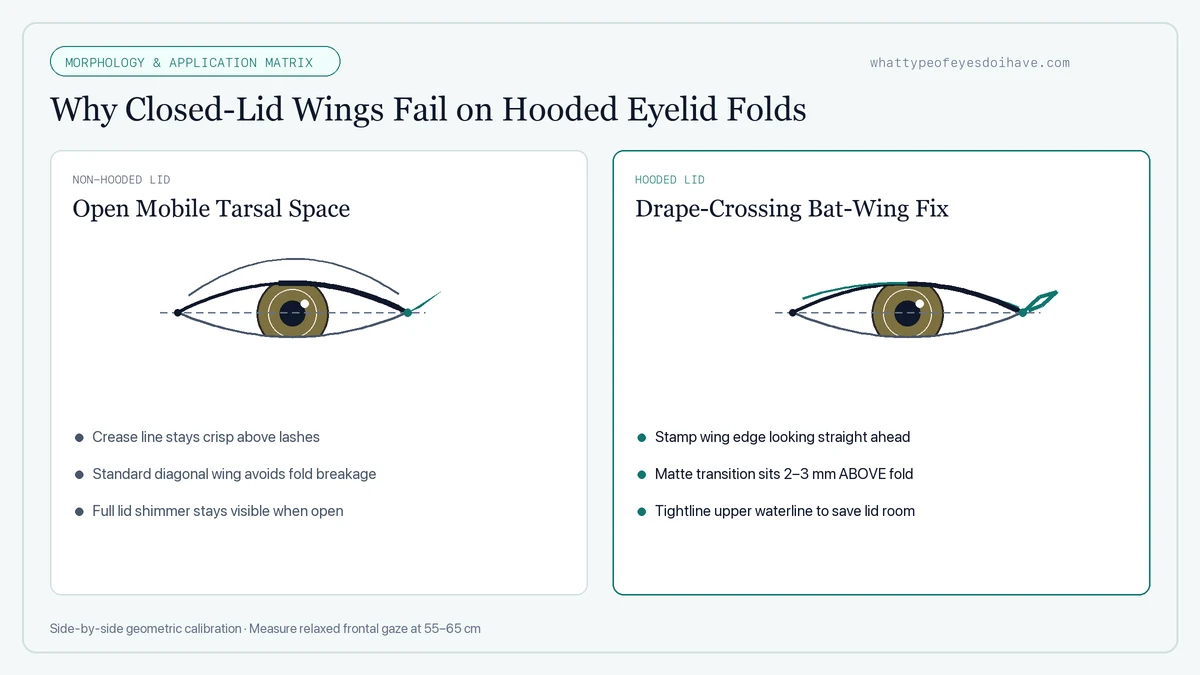
Drawing smudge-resistant eyeliner across hooded geometry requires respecting where the lateral fold drops. Begin by placing a pinpoint dot at the exact lateral spot where your upper hood fold meets your outer corner line while staring strictly straight ahead. Connect your sharp wing outward toward the brow tail first, then drop the top edge straight inward over the hood crest in a tiny triangular 'batwing' step.
When closed, that connected shape looks gently stepped across the fold crest; the instant you look naturally forward, the upper fold tucks the geometric notch cleanly underneath so the visible wing flows horizontally sharp and unbroken. Always keep central upper liner microscopic—tightlining underneath upper lashes preserves every precious millimeter of visible mobile lid.
For full visual maps pairing open-gaze contour placement with smudge-proof matte heights, visit our detailed tutorial on eyeshadow for hooded eyes or review measurements inside the 42-metric sample eye report.
- Step 1: Anchor tightline pigment along the underside of upper lashes so zero skin gap shows.
- Step 2: Map the outward flick angle while looking directly ahead into level glass.
- Step 3: Connect back toward the outer pupil lash base keeping the line hair-thin across center lid.
- Step 4: Set upper crease fold lightly with translucent powder before layering matte contour.
Stopping Midday Transfer & Preserving Mobile Height
Even subtle hooding presses skin-to-skin during thousands of daily blinks, breaking down emollient kohl pencils and creamy stick shadows fast. Thin layers of silicone-based or polymer lid primer allowed to dry 45 seconds before powder placement lock pigment sharply in place without caking inside natural creases.
Keep frosted or metallic sparkle strictly along the narrow visible band near inner tear ducts and lower lash centers rather than washing high across the brow fold itself, where shimmer highlights soft tissue weight forward. Matte mid-tone neutrals placed slightly above the natural fold push visual weight cleanly upward and open your expression effortlessly.
Blot excess facial skincare away from your mobile lids before primer; leftover peptide serums or rich SPF around the orbital bone dissolve eyeliner binders rapidly.
Evidence & Field Observations
Community Patterns & Anthropometric Sources
r/HoodedEyes Community Consensus
Thousands of before/after tutorials confirm that drawing winged eyeliner strictly in neutral straight gaze ('batwing' or connected dot method) eliminates pinched, curved wing shapes immediately.
Working Runway & Bridal Artists
Upper tightlining plus lifting transition mattes 2 mm to 3 mm onto the supra-fold wall doubles perceived open-lid space in photography compared to heavy upper lash-line bands.
Reference Literature
Farkas LG. Anthropometry of the Head and Face (2nd ed.). Raven Press.
Defines upper eyelid crease distance, fold overhang landmarks, and orbital sulcus norms.
Pessa JE. An algorithm of facial aging: verification of Lambros's theory by three-dimensional stereolithography. Plast Reconstr Surg. 2000.
Examines orbital bone rim morphology and supraorbital tissue draping shifts over time.
Cosmetic Styling & Non-Medical Scope
Comparisons between hooded and non-hooded eyelid folds focus exclusively on visual proportion and cosmetic transfer prevention—never dermatologic, plastic surgical, or medical guidance.
Objective Photo Measurement
Test Your Own Photo in 10 Seconds
Skip mirror guesswork—upload one straight-on photo to measure your opening ratio, canthal tilt angle, upper lid crease, and natural iris shade with our free AI detector, or inspect our 42-metric Sample Report.
Frequently Asked Questions
Neither—many celebrated editorial models and actors have natural partially or fully hooded lids. Traditional tutorials simply need minor vertical calibration so pigment shows cleanly when open.
Yes. Mild facial asymmetry commonly gives one brow slightly heavier outer fold overlap than the opposite side. Adjust transition matte height slightly higher on the fuller fold so both sides balance visually at speaking distance.
Drawing wings along a downward vanity angle paints ink straight across the lateral skin fold that tucks inward upon looking forward. Mapping the wing angle first in straight neutral focus stops fold occlusion.
Not at all. Keep pearl or shimmer tight along the inner third corner and lower central lash line where skin lies smooth, while keeping the upper draping hood exclusively matte.