Eyeliner Shapes for Different Eyes: Wing & Tightline Chart
One crisp black cat-eye cannot serve every eyelid crease, corner tilt, and aperture ratio equally. Picking eyeliner shapes for different eyes hinges on three mechanical controls: start point, wing incline, and fold bypass.
Mastering eyeliner shapes for different eyes eliminates messy afternoon redraws once you tie brush paths to actual bone and lid mechanics. A circular 2.4x round aperture transforms cleanly with straight smoked elongation starting mid-lid, whereas a partially hooded or downturned crease requires precise early upward lift or open-gaze batwing notches so ink never crimps. Measure tilt degrees and opening width neutrally by running what type of eyes do I have before testing tomorrow's wing angle.
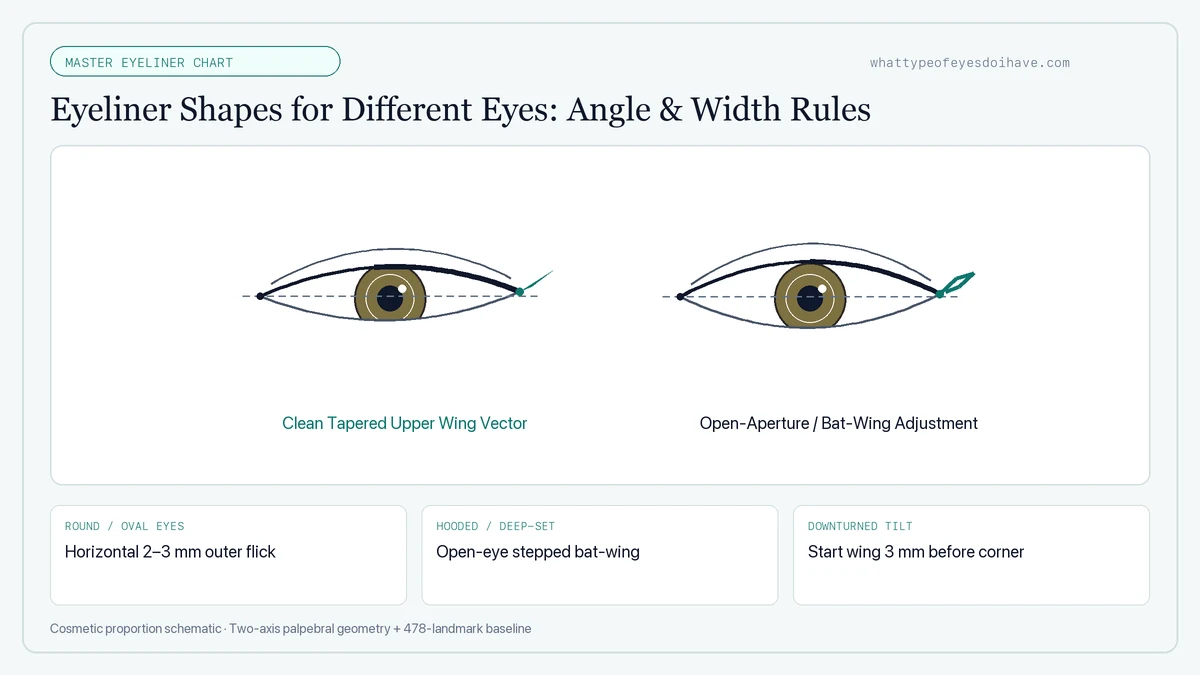
30-Second Liner Architecture Selector
Answer three straightforward landmark checks to pinpoint which wing geometry flatters your margins fastest.
Look directly forward: does a low outer brow-bone skin fold intersect the outer upper corner edge where wings normally sweep upward?
Compare outer corners against inner tear ducts: does either outer corner dip slightly horizontal or below medial tear-duct level?
Does central vertical opening height look rounded and tall rather than sleek and horizontally stretched?
Key Anatomical Benchmarks at a Glance
Where Ink Originates
Wide-set and parallel-fold structures carry crisp full-length lines cleanly; close-set and round shapes gain instant width by starting mid-lid above the pupil.
Exact Flick Tangent Angle
Flat 5° extensions lengthen vertical roundness cleanly, 15° lifts gently balanced ovals, while 25° lifts counter subtle negative downturn.
Bypassing Skin Crease Folds
Crossing thick ink squarely over dynamic outer skin folds causes jagged triangles unless bridged gently with open-gaze batwing notches.
Master Selector: 6 Eyeliner Shapes for Different Eyes
Match structural opening proportion and lid fold mechanics directly to concrete brush execution.
| Baseline Geometry | Line Start & Central Thickness | Wing Tail Angle | Critical Pitfall to Avoid |
|---|---|---|---|
| Almond / Oval | Past medial iris (0.6-1 mm thin) | 12° - 15° classic flick | Thick black ink crowding inner corner third |
| Round / Prominent | Outer half only; tightline inner roots | 5° - 10° elongated tail | Curling thick dome upward over middle lid |
| Hooded / Deep Fold | Zero middle paint; tightline underside | Open-gaze straight 8° batwing | Drawing flick with chin up & lids stretched |
| Downturned (-2°-) | Stop 2 mm before final drooping lash | 20° - 25° early lifted wing | Following drooping outer edge down to tail |
| Upturned (+3°+) | Outer third balance + lower corner smudge | 8° - 12° concise flick | Over-steep 40° vertical hook wings |
| Monolid Smooth | Graduated soft dark smudged base (1-2 mm) | 10° smooth smoked shadow tail | Micro thin line swallowed inside inward tuck |
Why One Universal Wing Always Breaks on Mismatched Lids
Scrolling beauty reels showcasing effortless felt-tip swoops overlooks why eyeliner shapes for different eyes exist in studio handbooks in the first place. Real faces pair six completely distinct orbital parameters—upper crease position, vertical opening height, spacing width, medial fold drape, socket depth, and corner slant—meaning identical wrist strokes paint radically different visual outlines depending on geometry.
Whenever liner pulls down at the corners, splits into broken stair-steps across a fold, or makes wide irises look smaller inside heavy framing, brush dexterity is rarely at fault. Simply recalibrating where black ink enters the upper margin and picking the right angular exit degree aligns wet pigment effortlessly with natural cartilage contours. Checking what shape are my eyes quantifies lateral tilt and visible lid clearance cleanly before lifting an applicator.
Notice that waterproof matte espresso gel pencils and fine synthetic angled brushes forgive small proportion adjustments far more smoothly than shiny black vinyl marker pens when tuning angles for the very first time.
- Angle Tangent Law: Every wing origin extends the visual upward trajectory of the lower lash curve, never the drooping upper margin.
- Contrast Economy: Dark black paint narrows white visual clearance; place thickness strictly along zones needing visual elongation.
- Open-Gaze Rule: Sketch your tail outline staring level into room mirrors so facial muscles sit in real posture.
Use taupe powder on an angled brush as an erasable stencil first when testing a brand-new flick slope before tracing permanent waterproof ink.
Round Apertures vs Oval Almond Wings: Pulling Width Horizontally
On circular round contours displaying lower white sclera margin beneath 2.55x opening proportions, painting an arched black dome peaking over the pupil heightens circular height even further—producing unintentional startled stares. Instead, ideal eyeliner shapes for different eyes in the round category hug ultra-thin tightline strictly underneath center upper lashes, introduce visible ink thickness solely across the outer fourth, and flatten wing elevation down around 5° to 10° horizontally sideways.
By lengthening lateral reach slightly outward past the actual corner rim without curving high upward, horizontally elongated flicks widen circular symmetry gracefully. Classic oval-almond proportions balance beautifully in contrast: keep central ink near half-millimeter width from inner iris ring outward, ending cleanly in crisp 12° to 15° kitten tips—explore companion shadow blends inside our eye makeup for almond eyes guide.
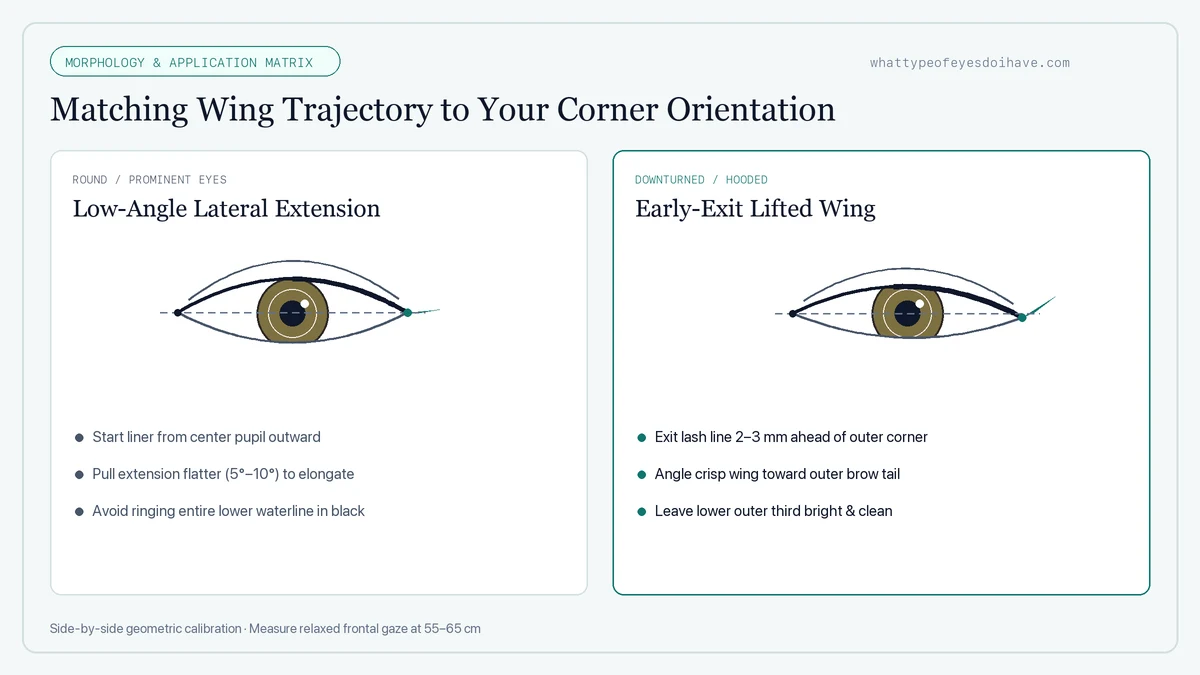
Batwing Notches for Hooded Folds & Early-Stop Lifts for Downturns
Two anatomical configurations trip people up most when decoding eyeliner shapes for different eyes: draped lateral hood folds and negative canthal downturns. On hooded folds, pulling an upward curve across relaxed outer creases crimps into jagged checkmarks upon forward focus. Beat fold overlap cleanly by placing your outward diagonal wing tail *beneath* the descending skin fold crest first, staring flat forward while connecting the upper tip edge gently back over the crease fold edge into a hollow step.
For natural negative canthal slopes sitting lower laterally than medial tear ducts, tracing ink right out to the very final outer corner hair drags your visual vector downward before turning upward—accentuating a 'droopy notch'. Instead, leave the tiny outermost 2 mm of upper rim bare clean skin, kick upward cleanly at 20°–25° early right from that pre-corner anchor, and sweep tiny dabs of bright peach concealer sharply underneath the lifting tail cleanly upward toward the hairline.
For stepped visual instructions dedicated solely to fold drape friction, follow our open-gaze diagram inside hooded eyes vs non hooded folds or preview custom tilt recommendations inside our 42-metric sample eye report.
Taming Upturned Tilt & Preserving Presence on Monolids
Strong upward corners above +3° already radiate elevated fox-like momentum naturally. Stacking extra steep vertical 35° wings atop naturally upturned geometry pushes outer ends abnormally toward temples while visually compressing mid-lid width. Opt instead for sleek nearly level horizontal extensions angled 8° to 12° blended subtly outward onto outer lower lash shadows—covered thoroughly in our upturned eyes eyeliner balancing guide.
Smooth monolids operate differently again: when flat lids tuck cleanly inward by 1–2 mm upon straight-ahead gaze, ultra-thin razor lines vanish totally upon blinking. Painting soft diffused charcoal or warm chocolate bands 1.5–2 mm tall right against curled upper roots (smudged upward softly before setting) gives soft depth visible cleanly upright without requiring oversized sharp ink slabs across open skin.
- Monolid Smoked Wing: Diffused kohl gel smudged gently upward holds crisp visibility across inward lash margin tucks.
- Reverse / Puppy Liner: Gently descending downward-angled smudge suits upturned edges wanting softer doll-like roundness.
- Lower Tightline Note: Reserve dark rim ink for large rounded shapes wanting smaller definition; keep slim openings strictly rimless.
Spacing Calibration: Close-Set vs Wide-Set Start Points
Selecting eyeliner shapes for different eyes works best when horizontal distance across the nasal bridge gets scored simultaneously alongside corner tilt. If intercanthal distance measures under 0.90 single fissure widths (close-set), avoid dark inner beaks and stop visible black liner around the medial iris border so visual focus stretches harmoniously outward toward temples.
If nasal bridge spacing exceeds 1.12 widths (wide-set), carrying razor-sharp thin definition or a pinpoint 1 mm tapered medial beak cleanly toward the inner tear duct closes visual gap subtly without touching lateral harmony. Pairing wing selection with accurate eyebrow shapes tailored to your eye spacing finishes proportion seamlessly across the entire upper facial third.
Use bright clean pointy cotton swabs moistened lightly with non-oily micellar water—never greasy moisturizer—to carve crisp upward under-wing edges cleanly before setting.
Evidence & Field Observations
Community Patterns & Anthropometric Sources
r/MakeupAddiction & Beauty Artists
Starting winged liner 2 mm inside the true lateral lash corner on downturned profiles is consistently rated the #1 immediate non-surgical eye-lifting adjustment.
r/HoodedEyes Wing Tutorials
Thin open-gaze batwing wings drawn with fine waterproof brush pens outlast chubby felt stamps 3x longer without blotting across lateral creases.
Reference Literature
Rheese SH, et al. Canthal tilt classification and aesthetic eye proportions. Aesthetic Plast Surg. 2012.
Quantifies neutral, positive, and negative intercanthal tilt angles across diverse cohorts.
Aucoin K. Making Faces. Little, Brown and Company.
Classical editorial reference for optical wing tangents and outer-corner lift balancing.
Cosmetic Styling & Non-Medical Scope
Liner start zones, degree tangents, and tightening methods serve purely aesthetic makeup engineering purposes; avoid pulling upper lids harshly sideways to prevent delicate skin friction.
Objective Photo Measurement
Test Your Own Photo in 10 Seconds
Skip mirror guesswork—upload one straight-on photo to measure your opening ratio, canthal tilt angle, upper lid crease, and natural iris shade with our free AI detector, or inspect our 42-metric Sample Report.
Frequently Asked Questions
Follow your upper crease behavior to select line thickness and notch shape (such as batwing vs continuous line), then follow outer corner canthal tilt to set wing elevation angle.
Matte chocolate gel pencil pressed onto a flat angled liner brush is much more forgiving than runny marker tips because you can feather lifted tails upward softly without hard step lines.
Dark pigment covering almost every millimeter of narrow exposed tarsal space eliminates visible light margin above lashes, making upper crease skin look lower and weightier.
Skip dark lower rim pencil entirely and start thin smoked outer flicks strictly over the lateral third, sweeping straight outward horizontally rather than upward.