Heavy Lids vs Hooded Eyelids: Orbital Weight & Brow Lift
Not every low-draped upper lid behaves identically. Distinguishing natural heavy lids from crisp thin-skin hooding determines whether shade placement or outer brow grooming brings instant lift.
People describing heavy lids often notice rich orbital fullness sitting directly between brow ridge and lash line, softening natural upper crease sharpness even with wide openings. Unlike crisp flat folds, true heavy lids pair fuller supra-orbital cushion thickness with modest brow-to-lash vertical room—meaning thick black liner or dense frosted shimmer compounds visual weight fast. Check how much brow-tail lift shows in a neutral snap by finding what type of eyes do I have before selecting socket colors.
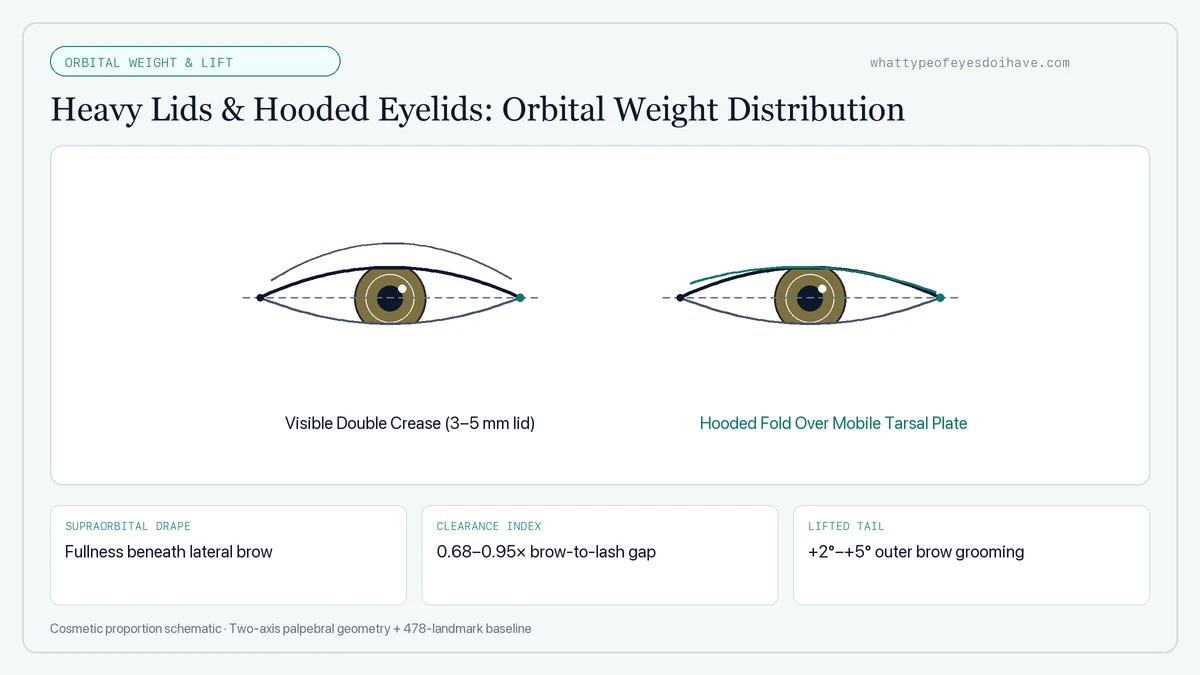
30-Second Supraorbital Weight & Brow Space Check
Rest your forehead gently so neither brow engages upward, then observe skin thickness directly under the outer two-thirds of each brow.
Does smooth upper skin directly beneath the brow arch feel visibly padded or curved forward, leaving limited flat recess space?
Does the gap between your upper lash root and brow lower edge measure narrow relative to central iris height?
Does applying frost white or pearl highlighter directly under the brow arch draw extra attention to lid thickness rather than creating lift?
Key Anatomical Benchmarks at a Glance
Dense Cushion vs Crisp Fold
Thin hoods fold flat like draped paper over the crease; heavy lids show smooth fuller tissue bridging directly from brow bone toward lashes.
Harsh Shimmer Under Arch
Reflective pearl under dense brow space magnifies forward projection—smooth matte bone shade visually recedes weight instead.
Brow Tail Feathered Lift
Trimming downward-hooking outer brow hairs opens 2–3 mm of crisp optical airiness instantaneously.
Heavy Lids vs Thin Hooded Folds vs Deep-Set Sockets
Spot which upper tissue signature drives your shadow behavior so you use matte depth effectively.
| Upper Trait | Brow-to-Lash Vertical Space | Tissue Behavior | Primary Lifting Strategy |
|---|---|---|---|
| Natural Heavy Lids | Compact (often < 1.2x iris) | Smooth convex supraorbital fullness | Soft matte diffused fog + lifted brow tail; avoid frost |
| Crisp Thin Hood | Moderate to tall | Clean loose crease flap over tarsal platform | Open-gaze matte contour 2-3 mm above crease crease |
| Deep-Set Hollow | High recessed socket wall | Prominent bone ridge casting deep shadow | Satin brightening cream right across mobile lid |
| Bedroom / Low-Crease Gaze | Relaxed low upper resting margin | Upper lid rests naturally lower over top iris | Tight upper lash curve + subtle warm taupe haze |
Heavy Lids vs Thin Hooded Folds: Spotting the Cushion Difference
Most style guides clump heavy lids and delicate hooded folds under identical tips, leaving people frustrated when sharp cut-creases fail on curved upper cushion contours. With thin crease hooding, a slim layer of skin simply hangs down across an underlying hollow notch. With natural heavy lids, the fullness radiates smoothly outward from the orbital cushion right below the eyebrow, softening vertical shadow boundaries.
Checking how upper light hits your orbit clears that confusion quickly. Step beneath normal overcast daylight and note whether strong dark creases show or whether upper tissue rounds forward cleanly toward your lash strip. Full-framed cushion anatomy imparts warm sultry intensity seen naturally across countless editorial portraits—often paired pleasantly with slightly relaxed resting margins.
Before picking rigid brush curves, upload one neutral front frame to our checker for what shape are my eyes to separate true upper-lid cushion compression from downward corner tilt.
- Touch Test: Lightly trace just below brow outer peak—dense soft curvature signals fuller cushion framing.
- Light Reflection: Bright overhead bounce lands prominently on full outer crests instead of sitting recessed.
- Vertical Clearance: Less room remains between lash border and bottom brow hairs, reducing cut-crease room.
Keep brow tails brushed slightly diagonally upward with clear strong-hold styling wax rather than flattening outer hairs downward toward the temple.
Why Shimmer Highlights Backfire on Fuller Orbital Tissue
In optical color theory, bright reflective shimmer reflects ambient photons back into the lens, pulling curved tissue closer to the viewer, while flat matte cool-neutral tones absorb bounce light and push volume gently backward. Applying frosted white bone highlight right underneath low outer arches literally spotlights heavy lids forward.
Swap metallic arch highlights for skin-matched ultra-fine matte pressed powder sweeping gently below the brow tail only to keep hairs neat. Reserve muted satin cream glow exclusively across the flat medial inner corner beside the tear duct where zero extra cushion protrusion exists.
To lift fullness gracefully, blend muted ash-taupe or warm mushroom matte along the upper rounded crest using large fluffy blending brushes held upright with zero downward drag—building seamless airiness rather than a crisp stripe.
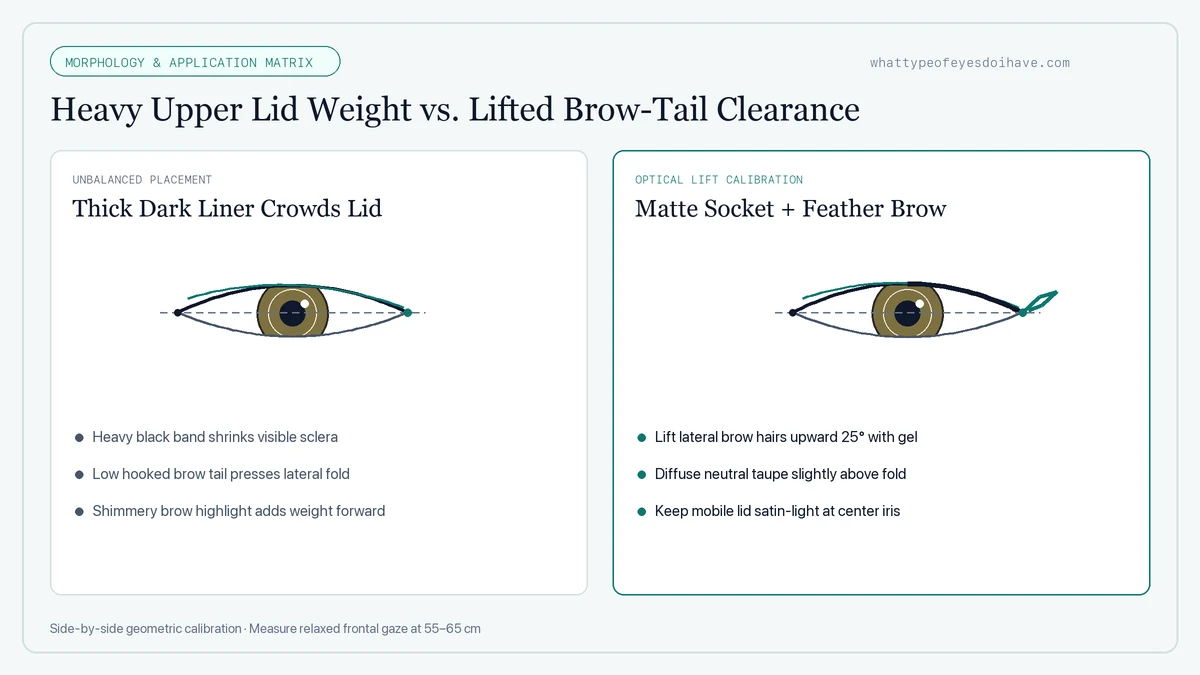
Opening Tight Vertical Space Via Lateral Brow Calibration
Because vertical separation between lashes and eyebrow undersides sits noticeably closer across heavy lids, just two millimeters of heavy downward eyebrow tail growth shrinks available styling canvas dramatically. Untrimmed outer hairs dipping lower than your inner brow baseline subtly drag the whole outer corner mood downward.
Hold a slim brush shaft horizontally across the inner head of your brow: avoid letting lateral tail tails drop cleanly below that level mark. Gently grooming lateral stray tail hairs upward opens crucial temple space for lifted outer eyeshadow transitions—see complete mapping rules inside our eyebrow shapes framing guide.
Notice that you never need severe thin razor arches; crisp clean edges strictly beneath the outer lateral third preserve healthy density while restoring generous open space above the corner crease.
Balancing Sultry Bedroom Upper Lids With Root Definition
Frequently, natural heavy lids coincide with gentle bedroom resting poise where the upper lash margin sits peacefully low along the upper iris edge. Heavy dark wings spanning the whole top curve collapse visible tarsal balance cleanly and make portraits look needlessly fatigued.
Replace thick upper liquid ink with invisible dark-brown tightlining nestled squarely along the inner lash waterline margin paired with tight root-curled lashes focused toward the middle-to-outer zone. Adding pinpoint micro-definition strictly past the outer corner keeps length airy—echoing clean tactics from our hooded vs non-hooded guide and benchmarked cleanly inside our 42-metric sample eye report.
- Tightline Only Inner Roots: Gives dense black lash root illusion without consuming lid space.
- Satin Mid-Tone Base: Neutral beige-rose or caramel across visible bottom margin keeps warmth clear.
- Curl Central Lashes Strongly: Sweeps hair shafts upward vertically across rounded outer shadow.
Using Subtle Lower-Lash Shadow as Vertical Balance
When top lid height stays compact underneath fuller supraorbital structure, shifting soft interest modestly downward beneath outer lower lashes grounds vertical proportion instantly. Pressing matte warm cocoa gently beneath the outer third lower lashes widens focus horizontally without drawing gaze up into cramped brow space.
Avoid harsh dark lower rim liner which compresses perimeter space vertically; instead keep lower inner edges clean or softly muted peach so horizontal clarity dominates effortlessly.
Dip an angled pencil brush lightly into neutral taupe contour powder and buff horizontally out past the outer corner—stopping precisely even with the lateral tip of curled lashes.
Evidence & Field Observations
Community Patterns & Anthropometric Sources
r/HoodedEyes & Mature Lid Styling Threads
Replacing icy brow-bone shimmer with skin-toned matte setting powder beneath the outer tail immediately reduces perceived upper lid puffiness in candid portrait lighting.
Editorial Brow Artist Consensus
Lifting lateral brow lamination hairs slightly upward rather than tapering sharp drooping tails restores 2–3 mm of breathable shadow room instantly.
Reference Literature
Farkas LG. Anthropometry of the Head and Face (2nd ed.). Raven Press.
Documents palpebral-to-superciliary distance intervals across adult craniofacial profiles.
Hwang K. Surgical anatomy of the upper eyelid relating to subbrow tissue fullness. J Craniofac Surg. 2013.
Examines retro-orbicularis oculi fullness versus superficial fold draping differences.
Cosmetic Styling & Non-Medical Scope
Supraorbital fullness and heavy lid comparisons describe healthy cosmetic shape variation for makeup balancing and grooming only—sudden asymmetry or functional vision drooping warrants medical eye-care evaluation.
Objective Photo Measurement
Test Your Own Photo in 10 Seconds
Skip mirror guesswork—upload one straight-on photo to measure your opening ratio, canthal tilt angle, upper lid crease, and natural iris shade with our free AI detector, or inspect our 42-metric Sample Report.
Frequently Asked Questions
Yes. Micro-tightlining upper lash roots combined with bright root-curled central lashes and soft matte contour brushed diagonally upward above the outer third creates crisp lift without sharp black wings.
Natural heavy lids maintain steady consistent orbital contour from teenagerhood forward regardless of hydration or sleep, whereas morning fluid retention fluctuates markedly between wake-up and afternoon.
Skin folds flex slightly faster over fuller rounded curvature while oil glues heavy sparkle into horizontal stripes. Fine silky matte or soft cream-to-powder formulas grip much more evenly.
Skip pearl highlighter directly under rounded tissue. Keep that zone cleanly skin-matte and place subtle cream radiance strictly on the medial inner tear-duct corner instead.