Deep-Set Eyes vs Sunken Eyes: Orbital Depth & Brightening
Heavy overhead brow-bone shadow frequently tricks cameras into making healthy deep-set sockets look fatigued. One simple flashlight chin check separates bony overhang from genuine orbital volume loss.
Unpacking deep set eyes vs sunken eyes starts by observing how three-dimensional brow rims interact with ambient lighting. Structural deep set eyes sit farther recessed inside a sculpted bony orbital socket underneath a pronounced supraorbital ridge, casting natural upper shadow across crisp creases while looking dramatically focused. By contrast, soft sunken eyes reflect flattened or thinned upper sulcus volume across the mobile hollow itself. Run a balanced window-light scan on what type of eyes do I have to compare orbital shadow symmetry first.
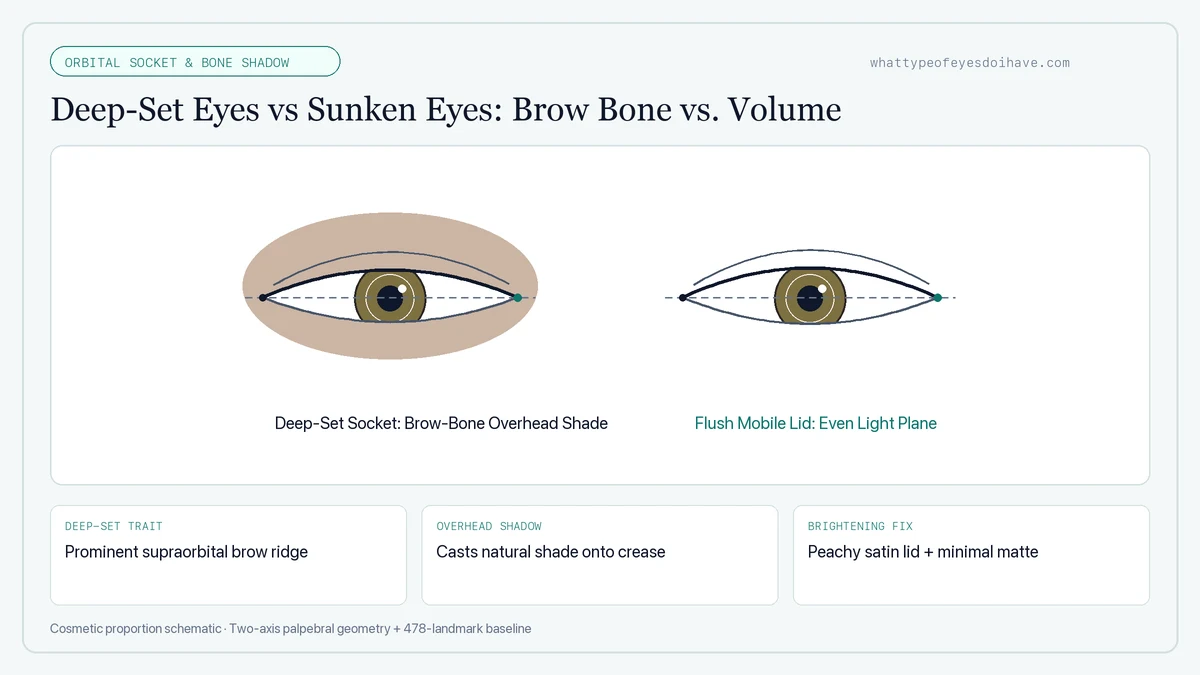
30-Second Overhead vs Frontal Light Check
Stand cleanly under room downlighting first, then walk straight toward a diffuse daylight window at eye level.
When turning sideways in profile view, does your bony eyebrow ridge project noticeably farther forward than the curved transparent cornea?
Do dark sockets brighten almost immediately the instant you walk out from overhead kitchen/office bulbs toward flat frontal daylight?
Do conventional dark brown socket eyeshadows make your gaze recede deeper and look prematurely tired rather than defined?
Key Anatomical Benchmarks at a Glance
Cast Shadow vs Sulcus Hollowing
Overhead fluorescent ceilings hit prominent brow ridges first, pooling artificial dark strips across healthy recessed mobile creases.
Permanent Bone vs Shifted Cushion
True deep-set anatomy appears early in adolescence via craniofacial rim contour; sunken sulcus hollows often fluctuate subtly with hydration or aging.
Skip Deep Dark Crease Packing
Putting charcoal inside an already deep cavity compounds hollowness fast—pull luminous neutral cream tones onto recessed mobile skin instead.
Orbital Depth Spectrum: Deep-Set vs Sunken Hollow vs Balanced
Spot how sagittal projection and upper crease light reflection guide corrective shading choices.
| Orbital Category | Brow Ridge vs Cornea Profile | Natural Lighting Response | Core Makeup Light Rule |
|---|---|---|---|
| Classic Deep-Set | Brow bone sits clearly ahead of cornea | Ceiling light drops strong upper lid shadow | Brighten whole mobile lid; skip dark inner crease |
| True Sunken / Hollow | Superior sulcus dips visibly concave under rim | Thin curved shadow groove persists in window light | Satin peach-cream lid base + zero deep hollow taupe |
| Balanced Neutral Depth | Brow ridge gently shields upper arch cleanly | Even uniform illumination across mobile crease | Balanced classic outer-V taupe + clean lid shimmer |
| Shallow / Prominent | Mobile curve sits near-flush with orbital margin | Catches light sharply across forward tarsal dome | Soft matte contour across center to gently ground |
Separating Deep-Set Orbital Framing From True Sunken Hollows
Confusing deep set eyes vs sunken eyes causes widespread misdiagnosis whenever overhead lighting hits a sculpted facial frame. Craniofacial orbital depth describes how far inward the globe rests inside the bony cone behind the anterior supraorbital margin. Across genuine deep set eyes, strong brow bones act like natural architectural sun visors—casting striking dramatic depth across upper lids even in joyful, fully rested childhood photographs.
True sunken or hollow contours (known anatomically as deepened superior sulcus lines) look distinctly different upon close frontal daylight inspection. Rather than a bold projecting brow arch overshadowing an open luminous mobile skin sheet, thin skin curves noticeably concave straight underneath the rim edge, exposing sharp crescent contour shadows across the upper lid cavity regardless of horizontal bulb position.
Evaluating portraits in uniform window light settles deep set eyes vs sunken eyes without drama. Upload one straight daytime portrait onto our analyzer for what shape are my eyes to isolate crease visibility from socket overhang cleanly.
- Profile Mirror Test: Hold a hand mirror beside your cheekbone; deep-set rims overhang noticeably ahead of curved lashes.
- Window Walk Test: Overhead bulbs exaggerate structural shadows horribly, while window light clears healthy deep-set lids instantly.
- Hooded Overlap Note: Deep-set sockets can coexist simultaneously with outer crease folds—compare heavy lids vs hooded fold weight.
Always place makeup vanity lights squarely at cheek-to-nose height beside your glass rather than solely from ceiling downlights above your head.
Why Standard Crease Tutorials Shrink Deep Sockets Immediately
Mainstream eyeshadow diagrams built around flatter neutral sockets insist everyone blend medium-dark mocha tightly inside the deepest hollow indentation to 'manufacture depth'. When someone with pronounced deep set eyes vs sunken eyes packs dense charcoal into a groove that already sits five millimeters shaded inward underneath brow overhangs, light drops right out of the cavity.
Instead of sculptural polish, painting dark brown straight into natural anatomical hollows pushes the iris farther backward into dim shadow, making portraits appear severely sleep-deprived on Zoom lenses or candid photography. What flatters recessed orbital sockets instantly is flipping tonal values upside down: illuminate recessed surfaces forward and gently mute only projecting outer bone crests.
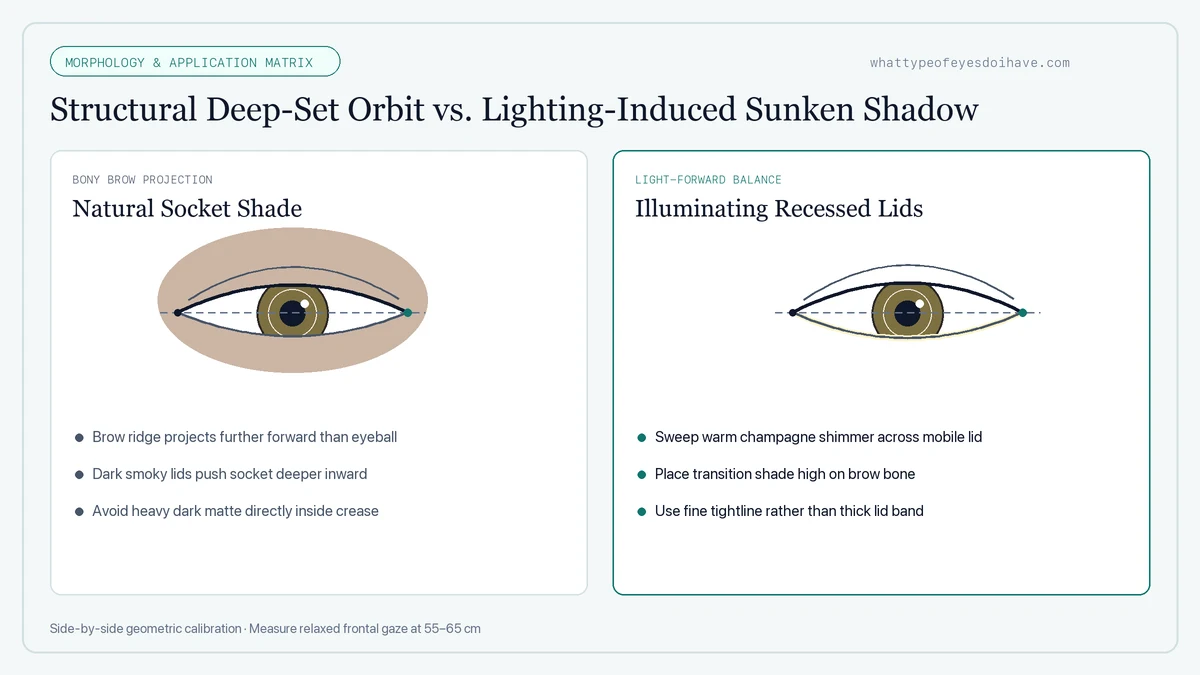
Satin Lid Illumination & Elevated Bone Shading
Brightening natural deep set and subtly hollow creases centers around lifting mobile skin brightness cleanly forward toward conversational light. Coat your entire visible mobile tarsal area smoothly using silky luminous bone, toasted vanilla satin, or subtle rose-champagne matte-sheen creams extending right up cleanly into the fold notch.
Next—crucially—keep darker medium cool-taupe transition shades completely *out* of the inward cavity itself. With gaze calm and level ahead, sweep muted neutral shading strictly along the projecting rounded anterior lip of your upper brow bone slightly above the hidden recess, blending upward just softly toward tail hairs. That elevated visual step pulls projecting bone backward while launching radiant central light forward effortlessly.
If dark shadows sit symmetrically beneath lower rims too, combine upper brightening moves cleanly with under-eye hollows vs dark circle pigment tactics alongside benchmark measurements inside our 42-metric sample eye report.
- Mobile Zone Focus: Smooth cream satin shadows reflect more even forward diffuse sheen than chalky frost powder.
- Liner Thickness Rule: Skip thick black upper lid lines—recessed corners shrink quickly beneath chunky stripes.
- Subtle Outer Wing: Keep micro-wings very slim strictly starting from lateral third outward cleanly into light.
Preventing Long Curled Lashes From Touching Brow Tissue
One practical everyday friction shared by genuinely deep set structures involves tall dramatic curls brushing sticky mascara straight onto overhead forward brow skin moments after application. Heavy straight-up lash crimps bump directly against overhanging anterior rim slopes cleanly.
Swap sharp L-angle vertical curls for sweeping diagonal outward J- or mild B-curl arcs combed gently horizontally out toward outer temples—or pair slim delicate outer half lashes from our eyeliner shapes guide. Choosing smudge-proof tubing polymer formulas guarantees that incidental gentle upper-rim grazes wipe off never leaving charcoal flecks beneath arches.
When Sunken Changes Signal Dehydration or Clinical Shifts
Lifelong deep set eyes follow inherited craniofacial skeletal scaffolding cleanly across decades. However, if previously bright smooth upper sockets suddenly deepen noticeably within weeks alongside persistent facial dullness, pronounced fluid depletion, drastic caloric weight loss, or localized discomfort on one single side, check hydration habits and review topical skincare actives carefully.
Gentle ceramic-rich moisturizing balm tapped carefully along outer orbital borders cushions dry thin crease lines visually—though any sudden unilateral volume shift or visual change belongs strictly with an examining physician or board-certified ophthalmologist.
Use thin luminous cream shadow sticks in soft warm pearl rather than matte powder shadows across dry sulcus hollows to keep skin texture supple and catch room light evenly.
Evidence & Field Observations
Community Patterns & Anthropometric Sources
r/MakeupAddiction Deep-Set Orbit Discussions
Eliminating dark crease shadows completely and placing pale satin beige across the whole lower recessed crease lid converts 'tired shadow look' into striking luminous brightness in minutes.
Tubing Mascara Feedback
Tubing polymers eliminate upper brow-ridge black smudging completely when deep-set outer rims graze upright lash tips during blinking.
Reference Literature
Farkas LG. Anthropometry of the Head and Face (2nd ed.). Raven Press.
Documents anterior orbital rim overhang versus exophthalmometry globe depth norms across populations.
Lambros V. Observations on periorbital and midface aging. Plast Reconstr Surg. 2007.
Distinguishes constitutional bony orbital depth from gradual upper sulcus fat-pad volume shifts.
Cosmetic Styling & Non-Medical Scope
Orbital shadow patterns describe non-medical chiaroscuro cosmetic strategies and lighting perception; consult a medical professional promptly for sudden unilateral orbital changes, rapid asymmetry, or visual disturbance.
Objective Photo Measurement
Test Your Own Photo in 10 Seconds
Skip mirror guesswork—upload one straight-on photo to measure your opening ratio, canthal tilt angle, upper lid crease, and natural iris shade with our free AI detector, or inspect our 42-metric Sample Report.
Frequently Asked Questions
Yes. Someone with naturally recessed bony orbits can also display thinner upper-sulcus hollowness directly beneath the rim ridge, making pale satin mobile-lid brightening twice as effective.
Natural bony brow projection already puts substantial authentic shadow into the lid crease; packing dark charcoal inside reinforces hollow shadow instead of adding sculpted definition.
Hold diffuse lighting directly in front at horizontal eye height: dramatic dark pools from brow shadow vanish immediately on healthy deep-set lids, whereas true sunken sulcus crevices still hold narrow curved groove contrast.
Tightline upper lash roots thinly to boost clarity without shrinking vertical space, and sweep warm peach-nude across the lower waterline to keep the recessed fissure visibly bright and airy.