Eyebrow Shapes for Your Eye & Face Shape: Mapping Guide
Chasing viral boxy soap brows without reading inter-corner spacing or upper eyelid overhang throws off whole facial balance fast. Three fixed anatomical vectors anchor flattering arches cleanly every time.
Selecting balanced eyebrow shapes starts from below rather than floating blindly up across the forehead: inner tear-duct distance, lateral iris boundary, and upper brow-bone crease fold dictate exactly where hair fullness belongs. Instead of forcing thin straight Korean brows onto round deep sockets—or steep arched curves onto narrow long faces—matching your three personal eyebrow shapes vectors harmonizes aperture proportion effortlessly. Measure intercanthal spacing ratio via our tool for what type of eyes do I have before plucking a single hair.
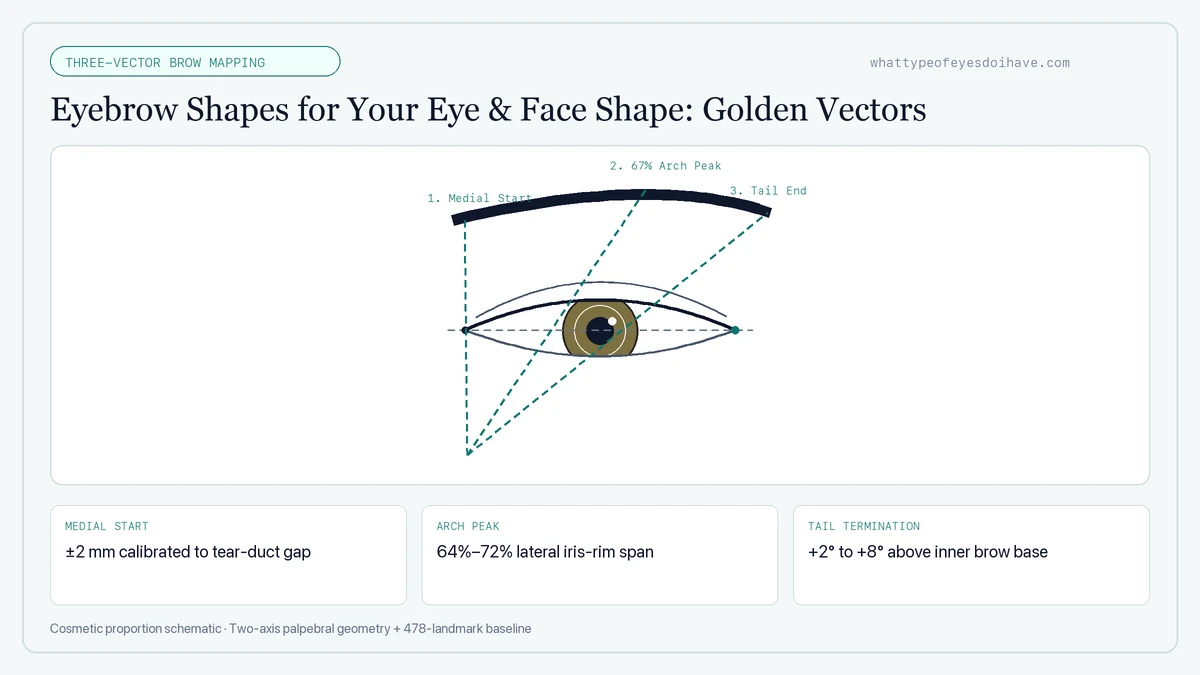
30-Second Three-Vector Pencil Alignment Test
Rest a clean thin makeup brush shaft gently straight up alongside your nostril wing while facing directly ahead.
Hold the brush straight vertically beside your inner tear duct: do natural brow front hairs stop slightly outside that line rather than creeping close across the center bridge?
Follow a line from tip of nose past outer edge of colored iris while calm ahead: does your natural brow arch sit around two-thirds across brow length?
Check horizontal alignment between inner brow base and outer brow tail tip: does the tail sit level with or subtly above your inner base height?
Key Anatomical Benchmarks at a Glance
Spacing Controller (Bridge Width)
Starting brows 1–2 mm farther lateral opens constricted close-set spacing; gentle inward feathered extension balances wide-set gaps softly.
Shape & Length Counterbalance
Classic arches peak roughly two-thirds along total brow length above outer iris border—flatter arches soften wide oval roundness; softer gentle arches calm sharp square jaws.
Lifting Outer Crease Weight
Never let brow tail tips dip clearly below the lower inner head level or lateral outer eye corners will immediately look visually dragged downward.
Tailoring Eyebrow Shapes to Baseline Eye Aperture & Spacing
Sync arch steepness, inner starting offset, and tail finish cleanly with measured periorbital geometry.
| Baseline Geometry | Medial Head Placement | Ideal Arch Curve & Height | Tail Exit Rule |
|---|---|---|---|
| Almond / Balanced | Aligned cleanly vertically above inner tear duct | Soft classic gradual arch peaking at ~67% | Finish softly slightly above inner head level |
| Round Aperture | Slightly crisp feathered alignment at medial line | Defined medium-high angled arch adds horizontal poise | Avoid ultra-round crescent arches mirroring round circle |
| Hooded / Heavy Lids | Clean medium upward brush strokes; avoid thick blocks | Gentle lifted outer arch clearing tight outer crease | Trim downward outer tips cleanly upward toward temple |
| Close-Set (< 0.90x) | Step inner head 2 mm laterally outward from center | Shift arch gently outward (70%) pulling width wide | Extend slender clean tail softly toward temple |
| Wide-Set (> 1.12x) | Extend gentle micro-strokes 1-2 mm medially inward | Softer natural peak (~62-65%) drawing inward focus | Keep outer tail crisp & concise—avoid dragging outward |
| Downturned Corners | Even neutral horizontal height inside bridge | Soft straight-up lifted arch balancing negative tilt | Keep tail cleanly elevated well above horizontal base |
Why Nostril Mapping Fails Without Eye-Corner Calibration
Standard salon stencils instruct every single customer to balance eyebrow shapes strictly from the outer wing of the nostril. What happens when someone pairs a delicately narrow nostril bridge with wide-set spacing, or wider nostrils with tight close-set tear ducts? Blind nostril-aligned stencils force brows wildly too narrow or awkwardly pinched inward!
Smart studio calibration replaces nose guessing with intercanthal eye-centered mapping. Vector 1 anchors your brow head cleanly relative to the medial tear duct (shifting softly outward 2 mm if spacing measures close-set, or feathered subtly inward if spacing measures wide-set). Vector 2 finds the highest arch peak along a visual diagonal passing from nostril rim directly past the outer border of your colored iris (~65–70% out along the brow).
Vector 3 limits tail length: connect the nostril outer crease straight past the lateral outer eye commissure outward, halting any dark pencil stroke strictly *above* the horizontal plane of your inner brow bottom edge. Measure real bridge spacing first via what shape are my eyes to dial Vector 1 accurately.
- 67% Golden Arch Rule: Placing peaks dead center creates perpetual surprised semicircles; placing near two-thirds anchors harmonious elegance.
- Tail Level Cutoff: Lowering pencil tails vertically below inner brow height visually shrinks temple openness fast.
- Hair-Stroke Texture: Micro-brushed taupe hair lines mimic natural growth cleanly over thick block stamped pomade boxes.
Use fine cool-ash taupe eyebrow markers one full shade lighter than dark hair—or one shade deeper than pale blonde hair—specifically at the inner brow head to avoid harsh stamped squares.
Calibrating Arches for Hooded Folds vs Vertically Round Apertures
Pairing eyebrow shapes intelligently means recognizing mirrored symmetry versus intentional optical counterbalance. Consider round vertically open geometries: carving a thin exaggerated circular semi-circle brow echoes that exact roundness redundantly overhead. Switching to a cleaner slightly straighter brow featuring a delicate structured crisp corner peak introduces sophisticated angular length contrasting round softness cleanly.
For hooded or heavy upper folds, thick low-hanging lateral brow tails pinch precious vertical eyeshadow clearance right at the temple! Gently thinning solely those lowest hooking hairs beneath the outer lateral quarter while lifting remaining tail hairs slightly diagonally with clear wax unlocks open crease lift effortlessly—read companion shadow pairing in heavy lids vs hooded eyelids framing.
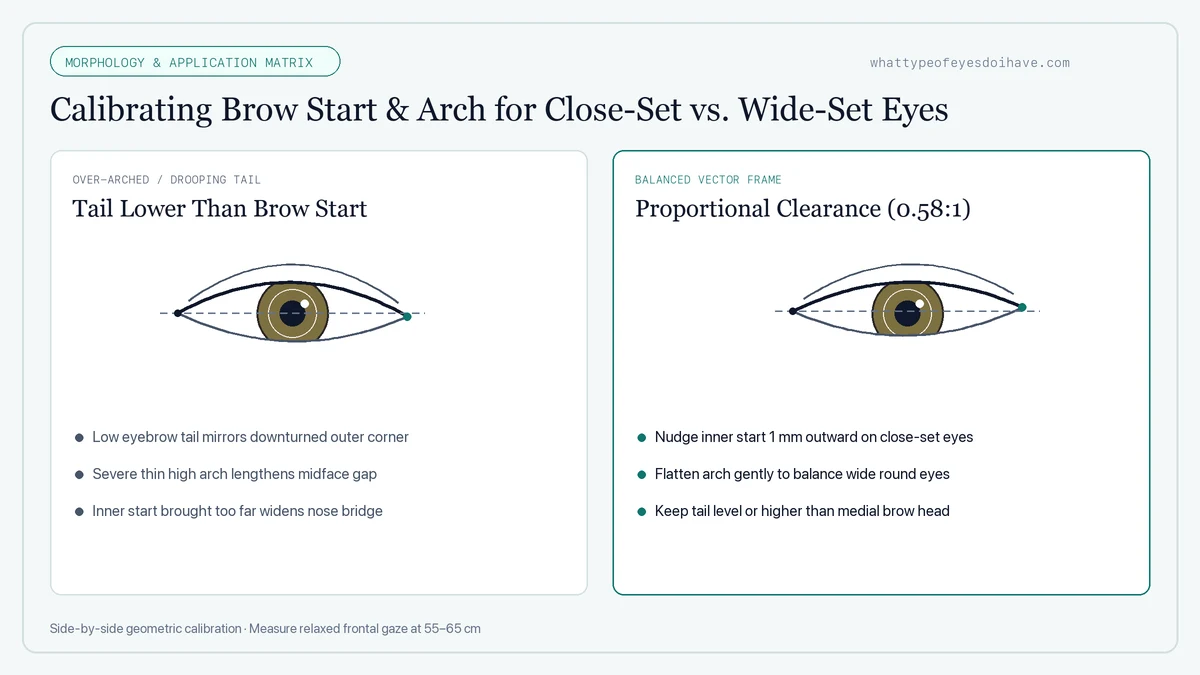
Resolving Bridge Width Illusions Using Brow Spacing & Straightness
Few beauty changes reshape horizontal facial proportions faster than nudging medial borders inside eyebrow shapes by two tiny millimeters. When normalized landmarks inside a diagnostic scan reveal close-set intercanthal ratio (< 0.90 single fissure width), avoid filling dark thick squares straight above tear ducts; brush clear holding wax vertically upward while shifting initial colored strokes 2 mm outward past medial edges and stretching outer brow tails delicately wider.
When bridge gap reads naturally wide-set (> 1.12 fissure widths), extending faint whisper-thin upward hair strokes softly closer toward the midline gently narrows bridge spread visually, while trimming overly long sweeping outer tails early keeps horizontal poise tight and centered—inspect bridge proportions neatly inside our 42-metric sample eye report.
Harmonizing Eye Brows With Oval, Square, Long & Heart Face Contours
Your brow frame mediates the crucial middle seam linking orbital geometry cleanly against jawline width across every face silhouette:
Across long oblong faces, sleek flatter horizontal eyebrow shapes featuring minimal modest arch lift visually widen upper proportions effortlessly without pulling vertical face height even taller. Across angular square jawlines, gently curved high-middle soft arches soften strong chin angles harmoniously. Across heart silhouettes carrying wider cheekbones and tapered chins, balanced rounded feathered curves hold upper forehead volume proportional gracefully alongside classic eye makeup for almond eyes ratios.
- Long Face Shape: Keep flat soft linear brows—high dramatic peaks visually stretch forehead length taller.
- Round Face Shape: Gentle structured lift past 67% breaks circular symmetry vertically.
- Square Face Shape: Medium feathered density with rounded top bend prevents sharp hard brow-jaw tension.
- Heart / Diamond Shape: Soft clean natural tail length avoids extending wider than widest temple points.
Plucking Restraint & Asymmetry Matching Without Over-Thinning
Almost every brow shaping regret begins leaning six inches close to magnified vanity mirrors plucking alternating sides unevenly. Hair follicles along upper margins grow slowly over months—reserve tweezing strictly beneath stray isolated below-arch hairs, keep top edge heights groomed evenly upward with angled clear gel first, and step back three full feet before balancing natural twin asymmetry.
Keep perspective grounded with our complete anatomical framework inside the eye shapes chart reference: eyebrows naturally exist as sisters rather than stamped clones, framing mobile iris expression cleanly rather than stiffening forehead emotion.
Before pulling any stray hairs, tint gaps subtly into your target silhouette using cool pale brow pencil first—pluck ONLY isolated stray dots standing clear outside your sketched blueprint.
Evidence & Field Observations
Community Patterns & Anthropometric Sources
r/Eyebrows Shaping Overhauls
Stopping downward brow-tail pencil drop so tails end level or lightly elevated above inner brow heads consistently lifts tired or slightly downturned facial expressions faster than concealer.
Aesthetic Salon Framing Guidelines
Anchoring front hair density softly transparent while reserving sharpest tint definition exclusively underneath the outer two-thirds avoids dated blocky stamp aesthetics cleanly.
Reference Literature
Farkas LG. Anthropometry of the Head and Face (2nd ed.). Raven Press.
Standardized intercanthal spacing ratios, superciliary arch points, and palpebral fissure widths.
Sclafani AP, Jung M. Desired position, shape, and contour of the female eyebrow. Arch Facial Plast Surg. 2010.
Evaluates ideal lateral brow peak positions (~67–70% lateral) across diverse facial geometries.
Cosmetic Styling & Non-Medical Scope
Eyebrow mapping vectors, bridge spacing offsets, and grooming angles address reversible hair styling and cosmetic filling solely.
Objective Photo Measurement
Test Your Own Photo in 10 Seconds
Skip mirror guesswork—upload one straight-on photo to measure your opening ratio, canthal tilt angle, upper lid crease, and natural iris shade with our free AI detector, or inspect our 42-metric Sample Report.
Frequently Asked Questions
Imagine a clean straight diagonal path linking your nostril outer edge through the lateral eye corner toward the temple—keep brow tail length ending neatly on that line while remaining level or slightly higher than your inner brow base.
Ultra-straight low-lying flat brows can gently weigh down tight heavy upper lids. Keeping a subtle 2–3 mm clean lift near the outer two-thirds opens room delicately without needing steep dramatic curves.
Keep front inner brow hair completely clear of heavy opaque pomade—simply set vertical front hairs upward with lightweight clear gel while shading fuller definition strictly outward past the medial iris edge.
Stencils impose static fixed arch spacing regardless of whether inter-corner gap runs close-set, average, or wide-set. Mapping inner start and 67% lateral peak straight against your own real eye corners adapts proportions effortlessly.