AI Eye Color Identifier: Daylight Iris Shade & Hex Guide
Camera white-balance drift and window reflections confuse human color guesses constantly. Mid-iris sampling in HSV color space separates green, amber, hazel, slate gray, and brown objectively.
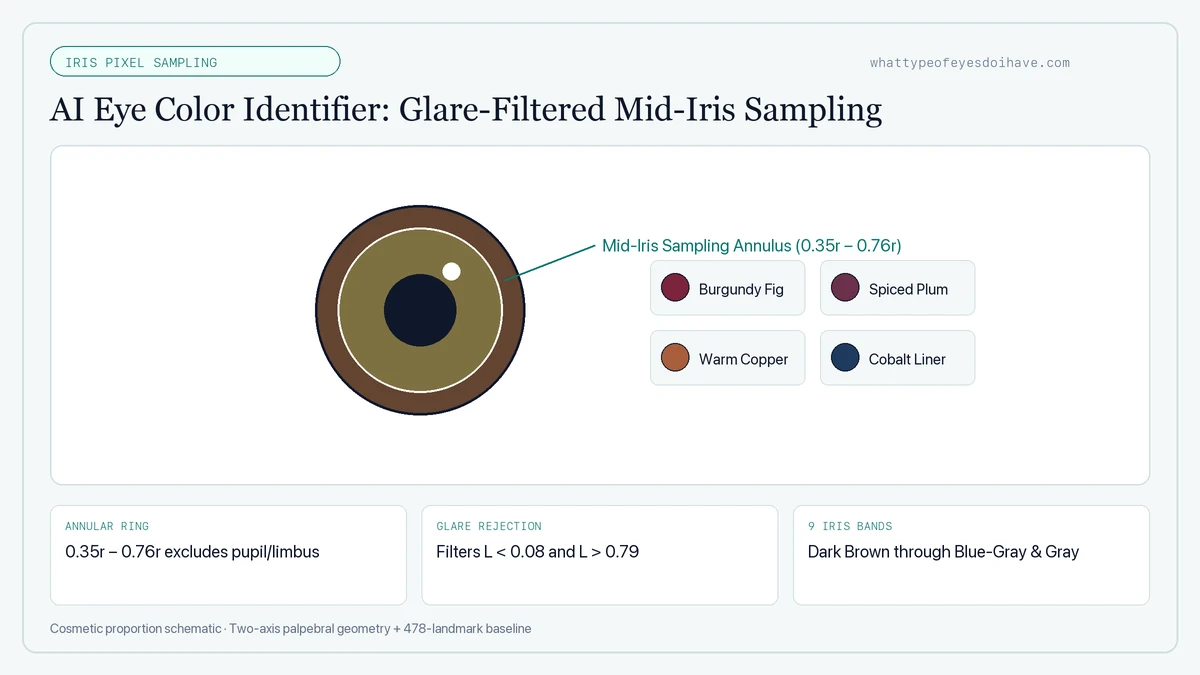
A reliable eye color identifier never averages raw whole-pupil pixels—doing so mixes dark center pupil black alongside harsh white window catchlights into false slate gray or muddy olive. True chromatic measurement samples strict radial rings midway between pupillary collarette and outer dark limbal ring, filtering specular glare highlights automatically before computing HSL hue peaks. Test your own iris zone cleanly right now inside our browser tool for what type of eyes do I have to see exact hex readouts and shade classifications.
30-Second Indirect Daylight Iris Readout Check
Face a clean overcast window holding calm straight focus without turning camera flash on.
Under steady window daylight, does your iris display two completely different rings—such as golden-brown rays radiating near the pupil into a distinctly olive-green outer circle?
Does your apparent iris shade appear to swing dramatically between sage green, slate steel, and sky blue depending strictly on shirt colors or indoor warm bulbs?
Do tiny dark brown freckles, warm golden flecks, or a pronounced dark slate outer limbal ring frame the perimeter around your colored ring?
Key Anatomical Benchmarks at a Glance
Window Glare & Overhead Warmth
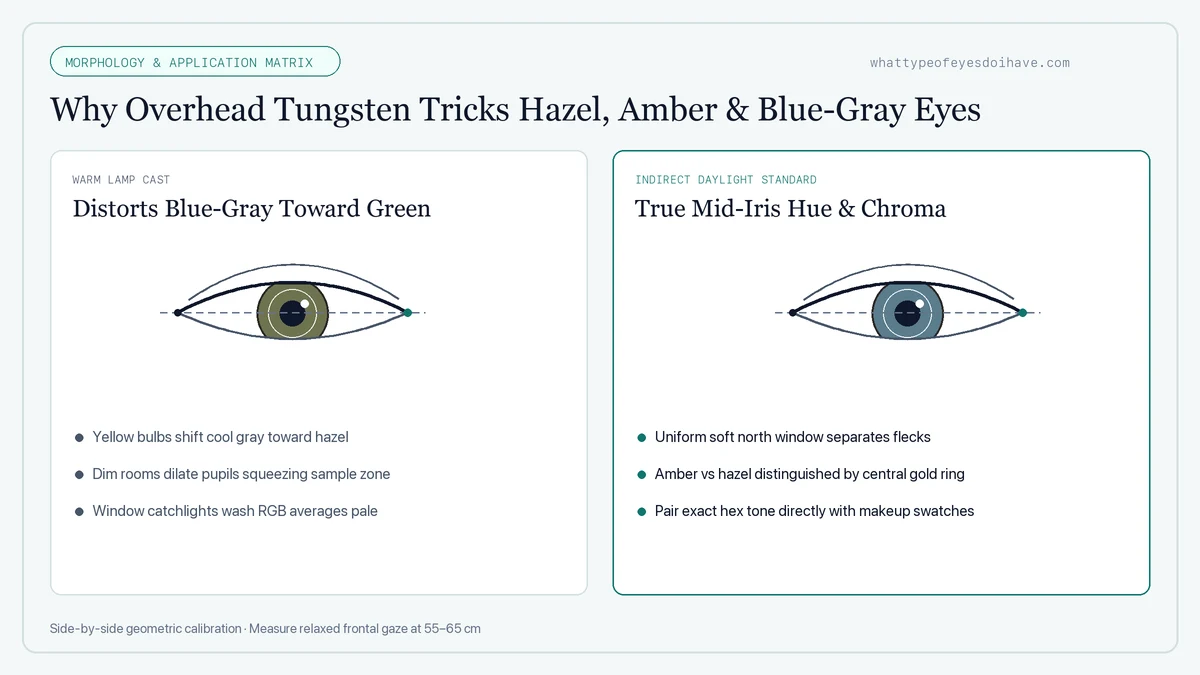
White bright reflection arcs skew luminance sky-high while 2700K yellow bedside lamps tint true slate-gray into apparent mossy olive.
Radial Hue Dispersion (Inner vs Outer)
True hazel displays gold-chestnut density around the collarette fading cleanly outward into green-olive stroma—not simply light uniform brown.
Why Gray-Green Appears to Shift Colors
Minimal melanin pigment leaves translucent stroma collagen scattering shorter blue-green wavelengths purely from reflected shirt and room hues.
Daylight HSV Reference Matrix Used by Our Eye Color Identifier
Compare measured stroma hue windows, radial zone uniformity, and common misclassifications.
| Shade Category | HSL Hue Band | Radial Ring Characteristics | Frequent Visual Lookalike |
|---|---|---|---|
| Deep / Classic Brown | 18° - 34° Warm Umber | High uniform eumelanin top to bottom; dark limbus | Dark Hazel under dim indoor shadow |
| True Amber | 36° - 46° Golden Copper | Solid uniform lipochrome gold warmth; zero green rim | Light Honey Brown in warm studio light |
| Multi-Zone Hazel | 32° Inner / 85° Outer | Distinct gold-brown inner spokes inside green-olive ring | Warm Brown (dim rooms) or Green (sunlight) |
| True Green | 88° - 135° Emerald/Moss | Low melanin + mild lipochrome across smooth stroma | Hazel or Gray-Blue depending on shirt hue |
| Slate Gray / Blue-Gray | 190° - 215° Low Sat | Ultra-low saturation translucent collagen scattering | Pale Blue or Seafoam Green outdoors |
| Classic Sky Blue | 200° - 225° Mid-High Sat | Zero melanin pigment; bright pure Rayleigh blue | Cool Steel Gray indoors under fluorescent bulbs |
How Computer Vision Filters Glare to Sample Authentic Iris Hex
Basic smartphone eyedropper apps fail miserably as an eye color identifier because they blindly grab whatever pixels lie in the iris radius—collecting glossy white glass reflections, dark upper eyelash cast shadows, and black pupillary void into one muddy gray hex calculation.
Our client-side landmark pipeline solves this accurately through three disciplined computer-vision steps. First, iris segmentation landmarks isolate the circular iris boundary cleanly inside the open fissure while strictly excluding the central pupil core (inner 32% radius) and darker peripheral limbal ring (outer 12% rim). Next, luminance filtering trims out extreme dark eyelash shadow pixels and clipped bright corneal specular glare patches.
Finally, remaining mid-stroma values run through HSL hue binning alongside radial dispersion variance checks to distinguish solid honey-amber from dual-zone hazel before printing your sampled swatch hex. Check your own exact sampled color card cleanly via what shape are my eyes or view a full breakdown inside our 42-metric sample eye report.
- Safe Mid-Ring Geometry: Isolates pure mid-stroma pigment clear of pupil border fuzziness and outer sclera fade.
- White-Balance Anchoring: Uses nearby sclera tone subtly to spot severe tungsten-yellow camera tint distortions.
- Zero Server Upload Required: Every pixel crop computes locally inside browser canvas memory immediately.
Stand facing an open cloudy daytime window at noon for five seconds without direct harsh sun rays squinting lids shut—diffuse north-window daylight yields truest HSL fidelity.
Hazel vs Amber vs Central Heterochromia: Clarifying Multi-Zone Rings
Confusion across golden-tinted shades sparks nonstop debates among friends asking what a digital eye color identifier should label multi-ring irises. True uniform amber remains statistically uncommon—driven by dense pale-yellow lipochrome pheomelanin yielding an unbroken warm gold-copper glow from pupil to rim without green flecks.
Classic hazel, by contrast, displays continuous radial blending: warm cinnamon or gold-brown concentration radiates smoothly outward from the collarette into dusty moss or sage-green periphery. Distinct central heterochromia presents a sharply etched contrasting inner ring (for instance, bright gold starburst strictly encircling the pupil against an otherwise solid sky-blue or emerald outer field without hazy mid-blend).
Why Light Scatter Makes Blue, Green, and Gray Appear to Shift Shades
People often ask how an eye color identifier handles irises that visibly 'change' color from icy silver to sea-green depending on weather or clothing. Human irises contain no blue or green structural dye—instead, translucent anterior stromal collagen layers simply contain very little dark brown melanin, allowing Rayleigh/Tyndall scattering (the identical atmospheric physics coloring daytime skies blue) to bounce short light wavelengths outward.
Because structural scatter interacts cleanly with incoming light temperature and surrounding wardrobe reflections, pale sage or translucent slate-gray fields visibly borrow warm emerald warmth under foliage or crisp denim-blue near navy collars—without physical pigment shifting a millimeter.
Capturing Daylight Photos That Give Consistent Color Hex Codes
Testing any eye color identifier underneath warm amber bedside bulbs or magenta neon vanity strips skews green chroma straight toward muddy sepia brown. Standardizing your capture environment takes less than fifteen seconds cleanly in daylight:
Turn off colorful screen night-shift filters, wipe camera glass smudges gently, step cleanly toward indirect northern window exposure where sclera whites appear crisp rather than shadowed gray, and keep pupils mid-sized naturally without blazing blinding ring-flash directly straight into your cornea. Consistent luminance unlocks dependable palette hex swaps covered next inside our eyeshadow colors for green eyes and every iris palette guide.
- Avoid Ring-Light Halos: Direct frontal LED circles sit right across the prime mid-iris sample zone.
- Avoid Warm 2700K Bulbs: Yellow tungsten glow washes sky blue toward muted sea-green.
- Skip Heavy Beauty Filters: Portrait retouch filters automatically amplify contrast saturation artificially.
Translating Measured Iris Hex Into Complementary Wardrobe & Liner Shades
Once an accurate eye color identifier verifies exact warm vs cool stroma ratios, selecting crisp frame harmony turns deeply predictable. Muted opposing hues across color-wheel wheels make natural pigment luminance surge effortlessly: garnet plum highlights green stroma sparkles without sparkling shadow, warm terracotta-copper ignites cool ice-blue clarity, and olive moss intensifies warm honey-hazel streaks seamlessly.
Even eyewear frame metals respond clearly: warm bronze and gold wire frames harmonize rich golden-collarette tones whereas sleek brushed titanium and cool gunmetal flatter slate-gray apertures sharply—linking nicely with our complete eye shapes chart ratios when selecting balanced eyeglasses frames.
Compare two portraits wearing plain crisp white versus charcoal neutral t-shirts next to identical window light to confirm your genuine resting stroma hex cleanly.
Evidence & Field Observations
Community Patterns & Anthropometric Sources
r/eyes & Genetics / Color Discussions
Thousands of comparison posts prove identical hazel irises look solid chocolate brown under dim indoor lamps yet ignite bright emerald-amber strictly beside natural window daylight.
Portrait Photography Studio Practice
Using white sclera exposure as an intuitive sanity baseline guarantees warm camera Auto-White-Balance hasn't shifted slate-gray into yellow-olive.
Reference Literature
Sturm RA, Larsson M. Genetics of human iris colour and patterns. Pigment Cell Melanoma Res. 2009;22(5):544-562.
Explains eumelanin/pheomelanin gradients, lipochrome golden amber density, and Tyndall/Rayleigh scattering in light irises.
Mackey DA, et al. Iris color grading and digital photography classification norms. Twin Res Hum Genet. 2011.
Documents standardized daylight iris imaging and mid-stromal radial color grading scales.
Cosmetic Styling & Non-Medical Scope
Automated digital iris color sampling serves aesthetic shade matching, cosmetic color wheels, and creative self-discovery strictly—never clinical ophthalmology, iris pathology screening, or genetic ancestry inference.
Objective Photo Measurement
Test Your Own Photo in 10 Seconds
Skip mirror guesswork—upload one straight-on photo to measure your opening ratio, canthal tilt angle, upper lid crease, and natural iris shade with our free AI detector, or inspect our 42-metric Sample Report.
Frequently Asked Questions
By sampling radial pixel zones independently: hazel displays elevated warm amber-brown hue saturation near the inner pupillary border paired with olive-green outer zones, whereas true green keeps cooler emerald-olive saturation uniformly wider across the mid-iris ring.
Lower ambient intensity widens pupils softly upward into inner brown melanin flecks while limiting shorter green-blue light scatter—only daylight brightness activates outer stromal scatter clearly.
True central heterochromia presents a crisp sharp-edged inner ring (often gold or rust) clearly contrasting against an unrelated outer color like pure blue or deep slate gray, rather than blending smoothly together.
Yes—bright on-axis camera flashes reflect off inner choroid vessels and clip thin bright specular pixels right on top of the mid-iris zone. Always prefer diffuse natural indirect window light instead.