Under-Eye Hollows & Tear Troughs: Anatomy & Brightening
Piling full-coverage beige concealer onto structural tear trough grooves cannot flatten a real three-dimensional shadow—it simply paints gray-chalk thickness onto an angled valley.
Understanding under eye hollows solves the oldest cosmetic mystery quickly: why high-coverage foundations cover brown freckles cleanly yet leave stubborn crescent shadows staring straight back in bathroom selfies. Structural tear trough valleys trace down along the medial orbital bone rim ligament—catching directional downward shadow purely from geometry rather than skin discoloration. Check whole-orbit symmetry using our detector for what type of eyes do I have before mapping micro-dot concealer placement.
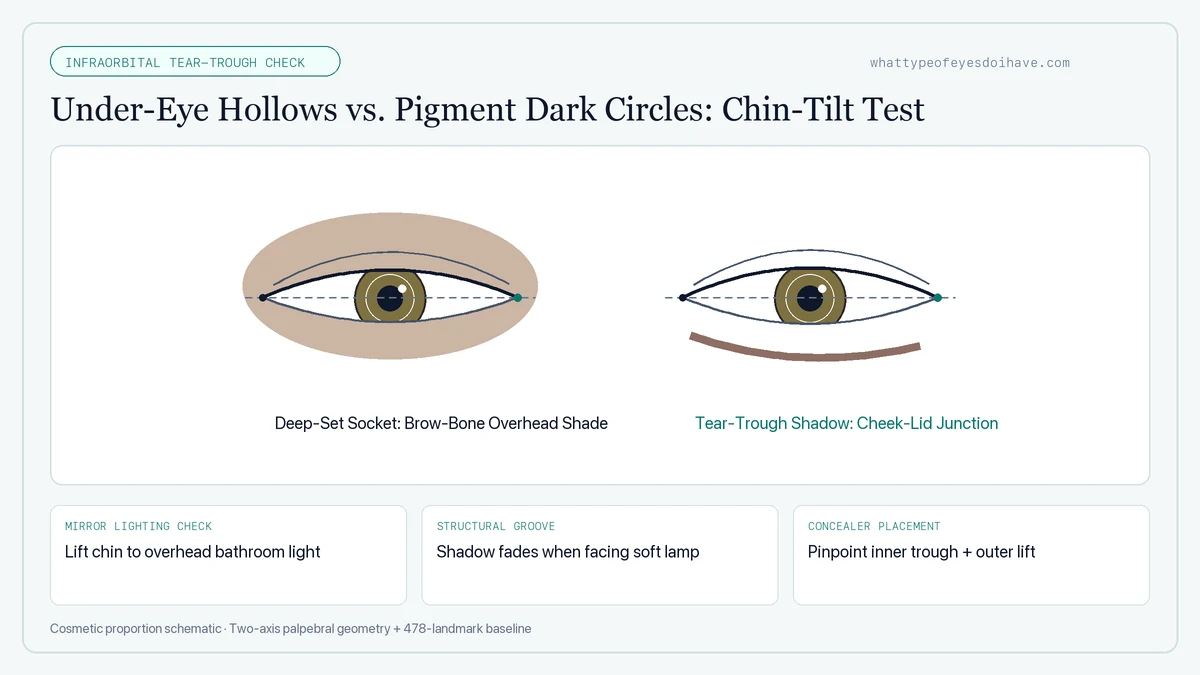
30-Second Chin-Tilt Shadow vs Pigment Check
Stand cleanly underneath overhead bathroom lighting holding a hand mirror at waist level, then tilt your chin slightly upward toward the ceiling light source.
As soon as direct light strikes your cheek-to-lid valley head-on, does the crescent dark line dramatically shrink or lighten nearly completely?
When gently touching lower orbital skin vertically downward, can you trace a slender curved rim depression sloping diagonally down from tear duct toward mid-cheek?
Does stamping thick concealer triangles all the way up under your outer lower lashes leave the groove looking noticeably chalky-gray yet still curved inward?
Key Anatomical Benchmarks at a Glance
Pure Structural Tear Trough
Formed by the orbital retaining ligament curving beneath thin lower lid skin; appears deeply dark under downward bulbs yet disappears under frontal softbox bounce.
True Surface Melanin / Vascular Tint
True skin tone shift caused by gentle translucent dermis showing capillary blood tone or golden-brown pigment that persists identically from all light angles.
Trace the Groove Only, Never the Ridge
Highlighting the already forward cheek pad below the valley worsens contrast steeply—place half-shade lighter brightness strictly inside the sunken canyon bottom.
Under-Eye Hollows vs Pigment vs Puffiness: Complete Field Guide
Stop buying heavier concealers until confirming which physical mechanism casts shadows below your lower lid.
| Visual Cause | Chin-Tilt Light Test Result | Surface Texture Profile | Correct Cosmetic Adjustment |
|---|---|---|---|
| Structural Under-Eye Hollows | Darkness vanishes noticeably facing light head-on | Smooth diagonal sunken indentation from nose | Thin micro-brush brightener strictly along trough valley |
| Vascular Blue-Violet Shadow | Tinted cool blue tone stays visible all angles | Even flat very delicate translucent dermis | Sheer peach-salmon neutralizer under thin skin-tint |
| Melanin Hyperpigmentation | Warm amber-brown hue persists evenly everywhere | Smooth uniform darker surface tone | Exact warm-bisque skin match (no gray light shades) |
| Sub-Orbital Bag Shadow | Sharp lower shadow underneath slight forward cushion | Soft anterior fullness casting bottom rim edge | Keep puff flat matte; brighten only dark lower crease line |
Why Gravity & Downlights Manufacture Artificial Tear Trough Darkness
Almost everyone panicking over sudden under eye hollows looks down under brutal overhead LED downlights first thing after waking up. Every human face carries a clear structural transition where thin mobile lower-eyelid dermis meets thicker midface cheek cushion along the medial tear trough ligament anchoring safely onto bony infraorbital margins.
Whenever ambient ceiling lighting shines vertically downward from above brow ridges, any gentle concavity dips smoothly out of direct light reach into physical cast shadow—creating stark curved stripes hugging lower cheekbones even across flawless rested complexions. Simply walking toward a clear side window or snapping one neutral front shot on what shape are my eyes confirms instantaneously how sharply flat illumination dissolves geometry shadows.
Recognizing cast optical darkness vs fixed surface hyperpigmentation saves countless dollars chasing stiff full-coverage cake-pots that crease awkwardly without shifting geometry.
- Trough Anatomy: Runs roughly 2 cm diagonally outward from inner nasal corner along the curved infraorbital bone lip.
- Flat Pinch Note: Lightly lifting outer skin sideways fades surface stretch tints weakly yet cannot fill recessed bone valleys.
- Mixed Realities: Thin fair dermis commonly blends slight natural purplish capillary glow right inside mild bony hollow shadows.
Test your own reflection holding one crisp white sheet of paper softly horizontally beneath your chin outdoors to bounce gentle upward daylight fill—cast tear-trough darkness disappears instantly while pigment stays visible.
The Precision Micro-Line Brightening Technique (Skip the Big Triangle)
Giant inverted concealer triangles plastered indiscriminately across upper cheeks completely ruin cosmetic balance over under eye hollows. Here is the exact spatial flaw: slapping bright pearl-ivory concealer across the raised cheekbone fat pad immediately *below* the groove makes that forward hill jump visually closer to viewers—forcing the untouched concave ditch right above it to recede even darker by contrast.
Instead, grab a flat micro-detail lip or spot liner brush dipped thinly into flexible luminous serum concealer only half to one step lighter than natural mid-face tint. Tip your head lightly downward so light clearly reveals the darkest inner shadow valley line sitting directly beneath your lower bulge, stamp thin pinpoint dashes strictly along the lowest valley floor itself, and tap vertically with a clean fingertip only along edges—never smearing lighter pigment upward onto upper cheek cushions or downward into puff crests.
Combining crisp lower valley leveling with soft upper crease brightening from deep-set eyes vs sunken socket tips lifts balanced periorbital clarity dramatically—compare natural symmetry benchmarks in our 42-metric sample eye report.
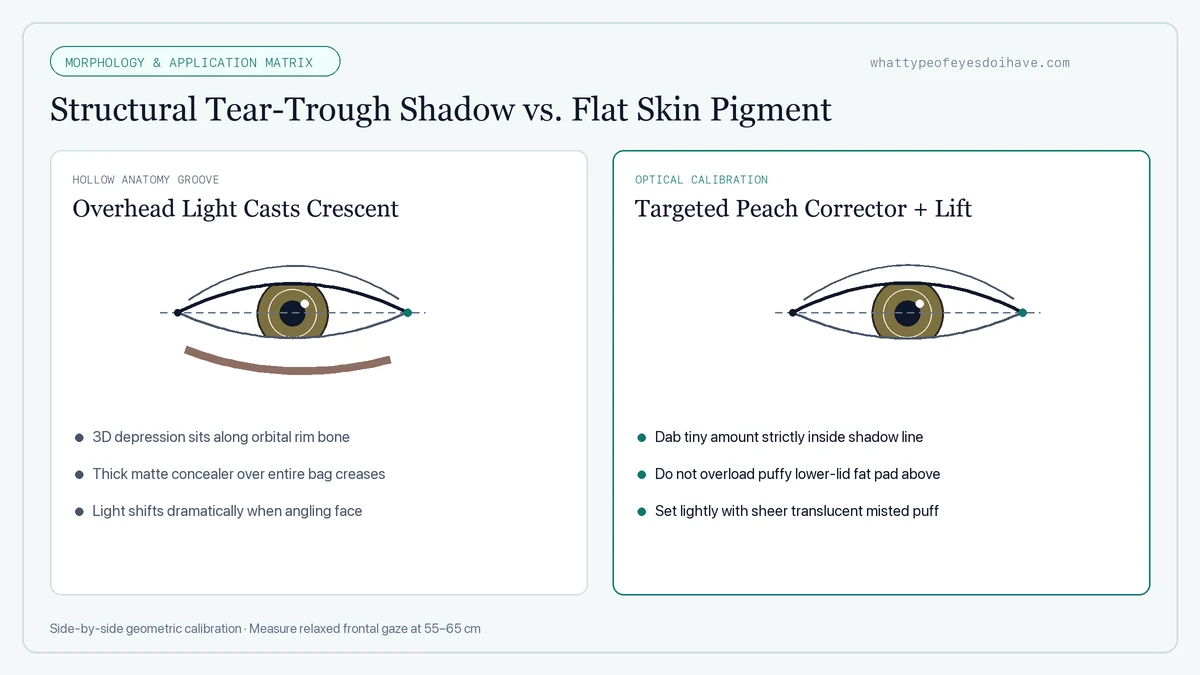
Handling Combined Hollows Plus Cool Blue Capillary Tone
Because lower eyelid skin remains the thinnest tissue zone anywhere on the human body (often near half a millimeter), genuine under eye hollows frequently reveal cool violet-blue capillary undertones shining subtly straight through smooth dermis right at the valley base. Coating bare blue undertones directly with pale beige foundation yields muddy gray-green casts instantly.
Pre-tap a microscopic whisper of peach, apricot, or warm orange-tinted liquid color corrector exclusively over discolored blue edges prior to thin skin-matching concealer—using sheer fluid viscosity rather than thick tacky cream balms. Peach wavelengths cancel cold blue-purple light optically without needing heavy putty layers that split cleanly inside expression lines.
- Fair Porcelain Skin: Choose whisper-sheer pale pastel peach—never bright heavy orange sticks.
- Medium Olive / Tan Skin: Smooth warm apricot or mellow bisque balances violet shadow invisibly.
- Deep Rich Complexions: Muted warm amber-terracotta neutralizes deep slate discoloration seamlessly without gray ash.
Micro-Setting Strategy: Preventing Crepe Texture & Graying
Dumping dense baking loose powder heavily beneath under eye hollows absorbs hydrating oils rapidly, emphasizing microscopic smile folds and magnifying surface dryness under natural light. Instead, stretch zero skin aggressively, blot any subtle surface product pooling carefully with a barely damp clean sponge after waiting ninety seconds for flexible polymer binders to set, and brush ultra-sheer finely milled translucent brightening powder strictly over the corrected groove using a tiny tapered shadow tip.
Keep heavy luminous liquid shimmer far away from curved tear-trough creases—shimmer draws eye bounce directly onto bumpy anatomical planes.
Distinguishing Genetic Tear Troughs From Temporary Fluid Fluctuation
Most pronounced under eye hollows sit visibly rooted cleanly along genetic cheek-bone midface contours inherited softly from relatives—visible long before age thirty under sharp vertical bulbs. However, short-term salt fluctuations, restless allergy congestion, chronic squinting, or sudden significant hydration changes temporarily accentuate lower shadow ridges visibly.
Consistent daily broad-spectrum UV mineral shielding around lower orbital bones protects delicate thin collagen networks long term, alongside calm pillow-elevated rest and mild caffeine-peptide hydration gels cleanly tapped before sunscreen.
Use satin-finish neutral concealer containing minimal silica shimmer reflection specifically inside the lower valley groove, then mist face subtly with plain hydrating setting spray to melt any chalk edges softly.
Evidence & Field Observations
Community Patterns & Anthropometric Sources
r/MakeupAddiction Tear Trough Pinpoint Method
Painting razor-thin light concealer solely inside the shadow fold crease using a tiny flat brush—and purposefully leaving upper lower-lash plumpness bare—remains the gold-standard trick across community before/afters.
Pro Photography Lighting Notes
Tilting faces slightly toward diffuse window fill confirms quickly whether shadow drops are physical structural grooves rather than dermatologic pigment.
Reference Literature
Hirmand H. Anatomy and nonsurgical correction of the tear trough deformity. Plast Reconstr Surg. 2010;125(2):699-708.
Maps exact osteocutaneous tear trough ligament geometry along the medial infraorbital orbital rim.
Roh MR, Chung KY. Infraorbital dark circles: definition, causes, and treatment options. Dermatol Surg. 2009.
Categorizes true pigmentary vs vascular vs structural shadow etiologies across infraorbital shadowing.
Cosmetic Styling & Non-Medical Scope
Concealer placement maps, peach color-correction rules, and lighting checks cover cosmetic camouflage of normal tear trough contours exclusively—consult a qualified dermatologist or ophthalmologist before medical aesthetic interventions.
Objective Photo Measurement
Test Your Own Photo in 10 Seconds
Skip mirror guesswork—upload one straight-on photo to measure your opening ratio, canthal tilt angle, upper lid crease, and natural iris shade with our free AI detector, or inspect our 42-metric Sample Report.
Frequently Asked Questions
Cool pale beige applied straight over structural shadow or translucent blue-violet capillaries mixes visually into muddy gray-ash without warm peach undertone correction and precision groove-only placement.
Leaving the slim natural cushion hugging directly beneath lower eyelashes free of thick concealer preserves delicate natural curvature (aegyo clarity) while keeping thin groove brightening sharp right below.
Hydrating eye creams plump surface epidermal lines gracefully for smoother makeup blending, though true ligament-anchored bony tear troughs rely physically on light angle and micro-spot optical camouflage rather than creams.
Overhead indoor downlighting casts crisp shadows inside concave infraorbital ridges, compounded by heavy cool camera exposure settings. Facing diffuse natural window daylight balances contrast instantly.